Understanding Gartner’s 2024 Magic Quadrant for Enterprise Backup and Recovery Software Solutions
Analyst house Gartner, Inc. has recently published its 2024 Magic Quadrant for Enterprise Backup and Recovery Software Solutions. This report highlights significant changes from previous iterations, reflecting the evolving landscape of data protection technology. According to Gartner, the marketplace encapsulates solutions that capture point-in-time copies (backups) of enterprise data across various environments, including on-premises, hybrid, multicloud, and Software as a Service (SaaS). These solutions are designed primarily to facilitate recovery in the event of data loss due to accidental, malicious, or environmental factors.
The Importance of Backup and Recovery Solutions
In today’s complex enterprise IT environments, the significance of robust backup and recovery solutions cannot be overstated. The need for reliable data recovery mechanisms is driven by an increasing array of threats, from cyberattacks to human error. Gartner emphasizes that solutions must not only simplify data protection management but also ensure dependable recovery from a widening range of risk scenarios.
Core Features and Capabilities
The criteria set by Gartner for evaluated solutions reflect the current market demands. Essential capabilities include:
- Protection of SaaS and Platform as a Service (PaaS) applications
- Centralized management consoles
- Incorporation of security functions
- Cyber recovery capabilities
- Comprehensive disaster recovery options
- Backup orchestration and automation
Additionally, Gartner notes that features like immutable backup integration and data recovery are increasingly essential. For on-premise systems, protection should extend to operating systems, databases, virtual machines, and applications, while cloud requirements emphasize the need for safeguarding Infrastructure as a Service (IaaS), PaaS, and Database as a Service (DBaaS).
Criteria for Evaluation
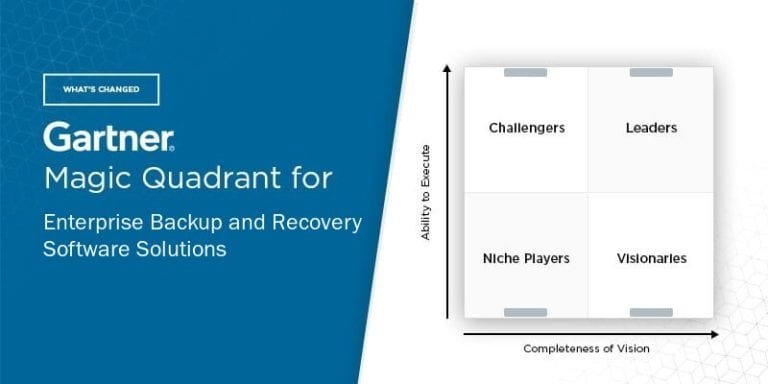
As software markets evolve, Gartner adjusts its evaluation criteria to align with industry trends. In this year’s Magic Quadrant, 13 vendors were analyzed for their strengths and weaknesses. The resulting framework categorizes these providers into four segments: niche players, challengers, visionaries, and leaders, based on their execution capabilities and completeness of vision.
Key Players in the Market
Gartner has identified a consistent lineup of leaders in the backup and recovery software market for 2024. Veeam, Commvault, Rubrik, Cohesity, Veritas, and Dell Technologies continue to occupy the top positions.
Veeam and Market Responsiveness
Veeam leads again in this year’s report, recognized for its recent product updates and managed backup services. Gartner highlights Veeam’s responsiveness to market needs, a critical factor for enterprises looking for adaptable solutions.
Commvault and Cyber Resilience
Commvault distinguishes itself with a comprehensive ecosystem and simplified licensing, focusing heavily on cyber resilience. The introduction of tools like Cleanroom Recovery, along with its AI initiatives, enhances its offerings, enabling customers to effectively plan and execute recovery scenarios.
Innovating with Rubrik
Rubrik continues to make significant strides through innovations stemming from its acquisition of Laminar, a data security technology firm. This has expanded Rubrik’s suite of cyber protection tools, leading to competitive pricing strategies for renewals and new deployments.
Noteworthy Acquisitions
Cohesity’s acquisition of Veritas’s NetBackup and Alta data protection software marks a pivotal move in the sector, seen as the most significant merger in over a decade. This strategic acquisition promises to bolster Cohesity’s already impressive portfolio.
Dell Technologies and Comprehensive Solutions
Dell offers a holistic solution package that bundles its data center elements—servers, storage, networking, and backups—allowing clients to streamline vendor relationships for an enhanced experience. Their APEX subscription option adds another layer of service flexibility.
Rising Stars in Data Protection
While there were no challengers this year’s quadrant, several companies are positioned to shift into the leadership category in the near future.
Druva’s Cloud-Native Approach
Druva stands out for its entirely cloud-native platform, offering simplicity and scalability for data backup-as-a-service (BaaS). It has positioned itself as the go-to option for cloud-first organizations, thanks to its global presence through partnerships with Dell.
IBM’s Performance Focus
IBM continues to drive innovation in backup performance through integrations with its storage solutions. The investment in container backup technologies and AI for threat detection places it in a competitive stance.
HYCU’s Unique Offerings
HYCU has emerged with a strong focus on SaaS and PaaS integrations, distinguishing itself with a diverse list of supported services. Their use of generative AI to expedite the development of data protection modules is particularly noteworthy.
Niche Players and Comprehensive Solutions
Arcserve remains at the forefront of niche players, offering flexibility with options for perpetual licensing. Meanwhile, Unitrends, Microsoft, and OpenText round out Gartner’s evaluation with their unique propositions, including unified administration, strong market alignment, and broad portfolio integrations.
Explore the Full Report
For a deeper dive into the Magic Quadrant for Enterprise Backup and Recovery Software Solutions, read Gartner’s report here. This comprehensive analysis provides valuable insights into the current state of enterprise backup solutions and highlights essential trends and capabilities vital for organizations navigating an increasingly complex data landscape.