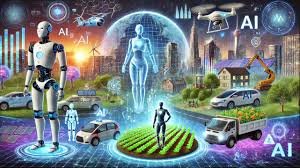
Artificial Intelligence is no longer a futuristic concept — it is a present-day force transforming industries, economies, and daily life. From generative AI tools to autonomous systems, innovation is accelerating at an unprecedented rate.
But what does the next decade hold?
In this deep dive, we explore expert predictions, emerging technologies, potential risks, and how AI could redefine work, business, and society.
AI Is Moving From Tool to Teammate
Early AI systems acted as automation tools. The next wave will function as intelligent collaborators.
Companies like OpenAI and Google DeepMind are developing advanced models capable of reasoning, planning, and multimodal understanding.
Prediction:
AI systems will increasingly act as:
- Research assistants
- Creative collaborators
- Business strategists
- Autonomous workflow managers
The shift from “automation” to “augmentation” will redefine productivity.
The Rise of AI Agents
AI agents — systems that can independently execute tasks — are emerging as a major trend.
Future AI agents may:
- Manage emails and schedules
- Conduct online research
- Execute transactions
- Coordinate multiple software tools
- Run small digital businesses autonomously
Autonomous AI workflows could drastically reduce manual intervention in routine operations.
Multimodal AI Will Become Standard
Current AI models can process text, images, code, and audio. The next generation will seamlessly combine all modalities.
Future capabilities may include:
- Real-time video analysis
- Emotion recognition
- Voice-to-action automation
- Context-aware decision-making
Multimodal intelligence will make AI systems more human-like in understanding and response.
AI in the Workplace: Major Transformation Ahead
AI will significantly reshape labor markets.
📌 1. Automation of Repetitive Jobs
Data entry, administrative tasks, and routine analysis will become AI-driven.
📌 2. New Job Categories
AI trainers, prompt engineers, AI ethicists, and automation strategists will grow in demand.
📌 3. Human-AI Collaboration
Workers will rely on AI copilots embedded in productivity platforms.
Tech leaders like Microsoft are integrating AI into enterprise tools, signaling that AI-first workplaces are becoming reality.
AI Regulation & Governance
As AI systems become more powerful, governments are increasing oversight.
Future developments may include:
- Global AI safety standards
- Mandatory transparency rules
- Bias and fairness audits
- AI licensing frameworks
Balancing innovation with ethical governance will define the industry’s long-term success.
AI in Everyday Life
Over the next decade, AI will become invisible yet deeply integrated into daily routines.
Expect AI-powered:
- Smart home ecosystems
- Personalized education platforms
- Healthcare diagnostics
- Financial planning tools
- Transportation systems
AI will move from novelty to necessity.
Edge AI & On-Device Intelligence
Instead of relying entirely on cloud servers, AI will increasingly run locally on devices.
Benefits include:
- Faster response times
- Reduced cloud costs
- Improved privacy
- Offline functionality
Smartphones, wearables, and IoT devices will host advanced AI models directly.
AI and Creativity
Generative AI is transforming art, music, coding, and content production.
Future creative AI systems may:
- Co-write novels
- Compose music collaboratively
- Generate films from text prompts
- Design full software applications
The line between human and machine creativity will blur.
Risks & Challenges Ahead
Despite its promise, AI presents serious concerns:
⚠️ Job Displacement
Automation could disrupt traditional roles.
⚠️ Misinformation & Deepfakes
AI-generated content may fuel misinformation.
⚠️ Security Threats
AI can be weaponized for cyberattacks.
⚠️ Ethical Bias
Improperly trained models may reinforce inequality.
Responsible AI development is crucial.
Long-Term Predictions (10+ Years)
Looking further ahead, experts speculate about:
- Artificial General Intelligence (AGI)
- Fully autonomous AI research systems
- AI-driven scientific breakthroughs
- Personalized AI companions
- AI-optimized smart cities
While AGI remains theoretical, incremental progress is accelerating.
Industries Most Impacted by AI
The sectors likely to experience the most transformation include:
- Healthcare
- Finance
- Education
- Manufacturing
- Cybersecurity
- Transportation
- Marketing & media
Businesses that integrate AI strategically will gain competitive advantages.
How Businesses Should Prepare
To remain competitive in an AI-driven future:
- Invest in AI literacy
- Pilot automation projects
- Establish ethical AI policies
- Monitor regulatory changes
- Focus on human-AI collaboration
AI adoption should be proactive, not reactive.
Final Thoughts
The future of AI is not about replacing humans — it’s about redefining human potential.
From AI agents and multimodal intelligence to edge computing and ethical governance, the next decade will reshape how we work, create, and innovate.
Organizations and individuals who adapt early will lead the next technological revolution.
Artificial Intelligence is not just the future of technology — it is the future of everything.
SEO FAQs
Q: What is the future of AI?
The future of AI includes autonomous agents, multimodal intelligence, workplace integration, and stronger regulatory frameworks.
Q: Will AI replace human jobs?
AI will automate certain tasks but also create new roles focused on oversight, strategy, and innovation.
Q: What is AGI?
Artificial General Intelligence refers to AI systems capable of human-level reasoning across diverse tasks.
Q: How can businesses prepare for AI advancements?
Invest in AI training, integrate automation tools, and develop ethical AI policies.