

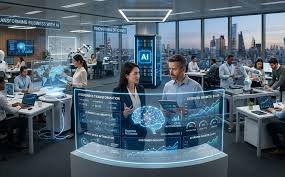
Artificial Intelligence (AI) is no longer a futuristic concept—it’s a core driver of innovation, efficiency, and growth in today’s business landscape. From automating routine tasks to delivering deep insights and enhancing customer experiences, AI is reshaping how companies operate across industries.
In this article, we explore how AI is revolutionizing business operations, its key applications, benefits, challenges, and what the future holds for AI-driven enterprises.
What is AI in Business?
AI in business refers to the use of intelligent algorithms and machine learning systems to perform tasks that typically require human intelligence. These tasks include decision-making, problem-solving, data analysis, and even communication.
Businesses leverage AI to:
- Automate repetitive processes
- Analyze large datasets quickly
- Improve customer interactions
- Make data-driven decisions
Key Applications of AI in Business
1. Customer Service & Support
AI-powered chatbots and virtual assistants provide instant responses to customer inquiries, reducing wait times and improving satisfaction.
2. Marketing & Personalization
AI analyzes user behavior to deliver personalized recommendations, targeted ads, and tailored content that boosts engagement and conversions.
3. Sales Forecasting
Machine learning models predict future sales trends based on historical data, helping businesses make informed decisions.
4. Human Resources (HR)
AI streamlines recruitment by screening resumes, analyzing candidate fit, and even conducting initial interviews.
5. Fraud Detection & Security
AI identifies unusual patterns in transactions, helping businesses detect fraud and prevent financial losses.
6. Supply Chain Optimization
AI enhances logistics by predicting demand, optimizing inventory, and improving delivery efficiency.
Benefits of AI in Business
Increased Efficiency
AI automates repetitive tasks, allowing employees to focus on more strategic activities.
Better Decision-Making
Data-driven insights help businesses make faster and more accurate decisions.
Cost Reduction
Automation reduces operational costs and minimizes human errors.
Improved Customer Experience
AI enables personalized interactions, leading to higher customer satisfaction and loyalty.
Competitive Advantage
Companies that adopt AI early gain a significant edge over competitors.
Real-World Examples of AI in Business
- E-commerce: AI recommends products based on browsing history and purchase behavior
- Finance: Automated trading systems and risk assessment tools
- Healthcare: AI assists in diagnostics and patient data analysis
- Retail: Smart inventory management and demand forecasting
Challenges of Implementing AI
High Initial Costs
Developing and integrating AI systems can be expensive for small and medium-sized businesses.
Data Privacy Concerns
Handling large amounts of data raises privacy and compliance issues.
Skill Gaps
There is a growing demand for AI specialists, which can be difficult to meet.
Integration Issues
Incorporating AI into existing systems can be complex and time-consuming.
Best Practices for Adopting AI in Business
Start Small
Begin with pilot projects to test AI capabilities before scaling.
Focus on Data Quality
AI systems rely on accurate and high-quality data to perform effectively.
Invest in Training
Upskill employees to work alongside AI technologies.
Choose the Right Tools
Select AI solutions that align with your business goals and needs.
Monitor and Optimize
Continuously evaluate AI performance and make improvements.
Emerging Trends in AI for Business (2026)
Generative AI
Businesses are using AI to create content, designs, and even code, boosting productivity.
AI-Powered Decision Intelligence
Advanced analytics tools provide actionable insights in real time.
Automation at Scale
Companies are automating entire workflows, not just individual tasks.
Ethical AI
Organizations are focusing on transparency, fairness, and accountability in AI systems.
The Future of AI in Business
AI will continue to evolve, becoming more accessible and integrated into everyday business operations. Companies that embrace AI today will be better positioned to innovate, adapt, and thrive in an increasingly competitive market.
From startups to large enterprises, AI is not just an option—it’s a necessity for sustainable growth and success in the digital age.
Conclusion
Artificial Intelligence is transforming the business world by enhancing efficiency, improving decision-making, and delivering exceptional customer experiences. While challenges exist, the benefits far outweigh the risks when implemented strategically.
Businesses that leverage AI effectively will not only survive but lead in the future economy.


