

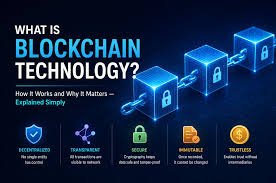
Blockchain technology has moved far beyond its early association with cryptocurrencies. In 2026, it powers financial systems, supply chains, digital identities, and even voting systems. From startups to global enterprises, blockchain is reshaping how data is stored, verified, and shared.
But what exactly is blockchain, and why is it so important?
🧠 What is Blockchain Technology?
Blockchain is a decentralized digital ledger that records transactions across multiple computers. Instead of relying on a central authority, blockchain distributes data across a network, making it secure, transparent, and nearly impossible to tamper with.
The concept was first introduced through Bitcoin, created by Satoshi Nakamoto in 2008.
⚙️ How Blockchain Works
At its core, blockchain operates through a sequence of steps:
1. Transaction Initiation
A user initiates a transaction (e.g., sending cryptocurrency).
2. Block Creation
The transaction is grouped with others into a “block.”
3. Validation
Network participants (nodes) validate the transaction using consensus mechanisms like:
- Proof of Work (PoW)
- Proof of Stake (PoS)
4. Block Addition
Once verified, the block is added to the chain in chronological order.
5. Immutability
The transaction becomes permanent and cannot be altered.
🔐 Key Features of Blockchain
🔒 Decentralization
No central authority controls the system, reducing the risk of failure or manipulation.
📊 Transparency
All transactions are visible on the public ledger.
🛡️ Security
Cryptographic techniques ensure data integrity.
⛓️ Immutability
Once recorded, data cannot be changed.
🌍 Real-World Applications of Blockchain
1. 💰 Cryptocurrencies
Blockchain powers digital currencies like:
- Bitcoin
- Ethereum
These enable peer-to-peer transactions without banks.
2. 📦 Supply Chain Management
Companies use blockchain to track goods from production to delivery, ensuring transparency and reducing fraud.
3. 🏦 Financial Services (DeFi)
Decentralized Finance (DeFi) platforms allow users to lend, borrow, and trade without intermediaries.
4. 🪪 Digital Identity
Blockchain enables secure identity systems where users control their own data.
5. 🖼️ NFTs (Non-Fungible Tokens)
NFTs represent ownership of digital assets like art, music, and collectibles.
🧩 Popular Blockchain Platforms
Several blockchain platforms dominate the ecosystem:
- Ethereum – supports smart contracts and dApps
- Solana – known for speed and low fees
- Binance Coin – powers the Binance ecosystem
- Cardano – focuses on sustainability
⚠️ Challenges of Blockchain Technology
Despite its advantages, blockchain faces several limitations:
🔻 Scalability Issues
Some networks struggle with transaction speed and costs.
🔻 Regulatory Uncertainty
Governments worldwide are still defining rules around blockchain and crypto.
🔻 Energy Consumption
Proof of Work systems can consume significant energy.
🔻 User Adoption
Complex interfaces can limit mainstream adoption.
🔮 The Future of Blockchain
Blockchain is expected to play a major role in the future of technology. Emerging trends include:
🌐 Web3 Development
A decentralized internet where users control their data and assets.
🏛️ Government Adoption
Countries exploring blockchain for voting, identity, and records.
🏦 Central Bank Digital Currencies (CBDCs)
Governments developing digital versions of fiat currency.
🤖 Integration with AI
Combining blockchain with AI for smarter, secure systems.
🌍 Blockchain in Africa: A Rising Opportunity
Africa is becoming a strong player in blockchain adoption, especially in countries like Nigeria.
Use cases include:
- Cross-border payments
- Financial inclusion
- Fraud prevention
Startups and developers are leveraging blockchain to solve real economic challenges.
🧠 Why Blockchain Matters
Blockchain is not just about cryptocurrency—it’s about trust.
It eliminates the need for intermediaries, reduces fraud, and empowers individuals with control over their data and assets.
🏁 Final Thoughts
Blockchain technology is one of the most transformative innovations of the 21st century. As adoption continues to grow, its impact will be felt across industries—from finance to healthcare and beyond.
Understanding blockchain today means being prepared for the decentralized future of tomorrow.
🔍 SEO Meta (Optional)
Meta Title: Blockchain Technology Explained: How It Works in 2026
Meta Description: Learn how blockchain works, its real-world applications, and why it matters in 2026. A complete guide for beginners and tech enthusiasts.
Keywords: blockchain technology, how blockchain works, crypto blockchain, Web3, decentralized systems, blockchain applications


