Blockchain technology has introduced many groundbreaking innovations, from cryptocurrencies and NFTs to decentralized finance (DeFi). One of the most transformative concepts emerging from the Web3 ecosystem is the DAO — Decentralized Autonomous Organization.
DAOs are changing how communities, businesses, and online projects operate by replacing traditional centralized leadership with transparent, blockchain-based governance systems.
In 2026, DAOs are being used to manage:
- Crypto projects
- Investment communities
- NFT ecosystems
- Online platforms
- Gaming communities
- Decentralized protocols
Supporters believe DAOs represent the future of internet-native collaboration and digital governance.
This article explores what DAOs are, how they work, their advantages and challenges, real-world applications, and what the future may hold for decentralized organizations.
🌍 What is a DAO?
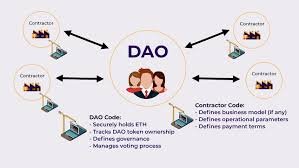
A DAO (Decentralized Autonomous Organization) is a blockchain-based organization governed by smart contracts and community voting instead of centralized leadership.
Unlike traditional companies, DAOs operate through:
- Transparent rules
- Community governance
- Token-based voting systems
- Decentralized decision-making
Members collectively make decisions regarding the organization’s future.
🔗 How DAOs Work
DAOs are typically built on blockchain networks like Ethereum using smart contracts.
Core Components of a DAO:
📜 Smart Contracts
Smart contracts contain the rules and logic that govern the DAO.
They automatically execute decisions once voting conditions are met.
🪙 Governance Tokens
Members usually receive governance tokens that allow them to vote on proposals.
Voting power may depend on:
- Number of tokens held
- Participation level
- Community roles
🗳️ Community Voting
Members vote on:
- Funding decisions
- Protocol updates
- Partnerships
- Treasury management
- Governance changes
This creates a more democratic organizational structure.
🚀 Why DAOs Are Growing in Popularity
DAOs align strongly with Web3 principles:
- Decentralization
- Transparency
- Community ownership
- Open participation
As blockchain adoption grows, more digital communities are exploring DAO governance models.
💡 Key Benefits of DAOs
🌐 1. Decentralized Governance
No single individual or company fully controls the organization.
Community members participate in major decisions.
🔍 2. Transparency
Blockchain transactions and voting records are publicly visible.
This increases accountability and trust.
🌍 3. Global Participation
Anyone with internet access and governance tokens can participate from anywhere in the world.
DAOs enable borderless collaboration.
⚡ 4. Automated Operations
Smart contracts automate many administrative functions.
This reduces:
- Manual processes
- Operational costs
- Centralized management overhead
🤝 5. Community Ownership
Members feel more connected because they directly influence the organization’s direction.
🛠️ Common Use Cases for DAOs
💰 Investment DAOs
Groups pool funds together to invest in:
- Crypto projects
- NFTs
- Startups
- Digital assets
🎮 Gaming DAOs
Blockchain gaming communities use DAOs to govern:
- In-game economies
- Virtual assets
- Community events
🖼️ NFT Communities
Many NFT projects use DAO structures for community governance and treasury management.
🌐 DeFi Protocols
Decentralized finance platforms use DAOs to manage protocol upgrades and ecosystem development.
Examples include:
- Uniswap
- MakerDAO
🔐 Security Risks & Challenges of DAOs
Despite their innovation, DAOs also face several challenges.
⚠️ Smart Contract Vulnerabilities
Bugs in smart contracts can lead to:
- Exploits
- Treasury theft
- Governance attacks
Security audits are essential.
🗳️ Governance Manipulation
Large token holders may gain excessive influence over voting decisions.
This can reduce decentralization.
📉 Low Community Participation
Some DAOs struggle with:
- Low voter turnout
- Community inactivity
- Decision-making delays
⚖️ Legal & Regulatory Uncertainty
Governments worldwide are still determining how to regulate DAOs legally.
Questions remain around:
- Taxation
- Liability
- Legal recognition
🌍 DAOs & the Future of Work
DAOs may significantly influence remote work and online collaboration.
Potential benefits include:
- Borderless employment
- Community-led projects
- Transparent compensation systems
- Decentralized freelancing networks
Web3 communities increasingly experiment with decentralized team structures.
🤖 AI & DAO Integration
Artificial Intelligence may enhance DAOs through:
- Automated analytics
- Proposal recommendations
- Fraud detection
- Smart treasury management
AI tools could improve efficiency and governance quality within decentralized organizations.
🌐 DAOs in Emerging Markets
Countries with growing crypto adoption, including Nigeria, are seeing increasing interest in DAOs for:
- Community investment groups
- Startup funding
- Creator economies
- Blockchain innovation
DAOs may provide alternative economic opportunities for digitally connected communities.
📊 Popular DAO Tools & Platforms
Several tools help manage DAO operations.
🛠️ Governance Platforms
- Snapshot
- Aragon
💬 Community Platforms
- Discord
- Telegram
These tools support decentralized collaboration and communication.
🔮 Future Trends for DAOs
🌍 Mainstream Business Adoption
More organizations may adopt DAO-inspired governance systems.
🔗 Cross-Chain DAO Ecosystems
DAOs will increasingly operate across multiple blockchain networks.
⚖️ Regulatory Frameworks
Governments may introduce legal structures for DAO recognition.
🤝 Hybrid Organizations
Traditional companies may combine centralized leadership with decentralized governance models.
🧠 AI-Powered Governance
AI systems may assist communities in analyzing proposals and improving decision-making.
⚠️ Are DAOs the Future of Organizations?
Supporters believe DAOs could revolutionize:
- Online communities
- Business management
- Investment coordination
- Digital governance
However, scalability, legal clarity, and governance efficiency remain major challenges.
DAOs are still evolving, and their long-term impact will depend on how effectively these challenges are addressed.
🏁 Final Thoughts
DAOs represent one of the most innovative ideas emerging from blockchain and Web3 technology. By enabling decentralized governance, transparent operations, and global collaboration, DAOs are reshaping how online communities organize and make decisions.
While challenges related to security, regulation, and governance remain, DAOs continue gaining momentum as more users embrace decentralized systems.
In 2026, DAOs are not just crypto experiments—they are becoming powerful models for digital collaboration, community ownership, and the future of decentralized organizations.