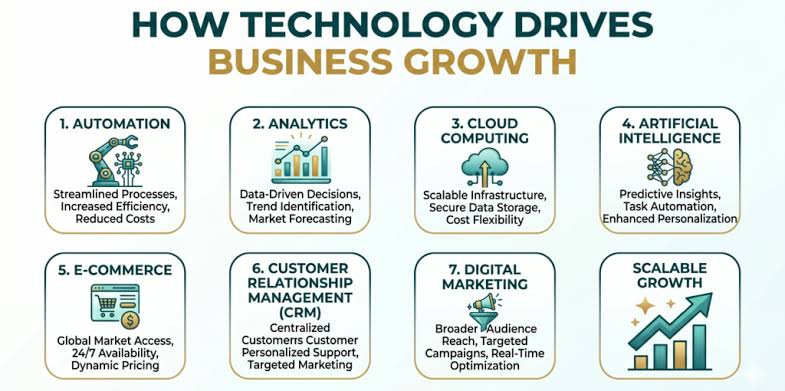
Technology has transformed marketing from a primarily creative function into a highly measurable, automated, and data-driven discipline.
Businesses can now use artificial intelligence, automation, customer data, analytics platforms, search optimization, social media, marketing software, and personalization technologies to reach potential customers more efficiently.
But having access to advanced technology does not automatically produce growth.
Successful businesses use technology to solve real marketing problems: understanding customers, creating valuable content, generating qualified leads, improving conversion rates, retaining customers, and measuring results.
This is where tech marketing and growth comes into play.
Tech marketing and growth combines modern technology with marketing strategy to help businesses attract customers, build relationships, increase revenue, and scale more efficiently.
What Is Tech Marketing & Growth?
Tech marketing refers to the use of technology, digital platforms, software, data, and emerging tools to promote products and services.
Growth marketing takes this approach further by focusing on the entire customer journey.
Instead of concentrating only on acquiring customers, growth teams examine:
- Acquisition
- Activation
- Engagement
- Conversion
- Retention
- Referral
- Revenue
The goal is to identify opportunities throughout the customer lifecycle and use data and experimentation to improve business performance.
Why Technology Matters in Modern Marketing
Traditional marketing can be difficult to measure precisely.
Modern technology allows businesses to track customer behavior across many touchpoints.
For example, a company can measure:
- Website visitors
- Search traffic
- Ad performance
- Email engagement
- Product usage
- Conversion rates
- Customer acquisition costs
- Customer lifetime value
This information allows marketers to make more informed decisions instead of relying entirely on assumptions.
1. Artificial Intelligence in Marketing
Artificial intelligence has become one of the most influential technologies in modern marketing.
AI can assist marketers with:
- Content creation
- Customer segmentation
- Predictive analytics
- Ad optimization
- Lead scoring
- Personalization
- Customer support
- Market research
AI can reduce the time required for repetitive tasks while helping teams analyze large amounts of information.
However, AI-generated marketing still requires human oversight. Brand positioning, accuracy, originality, and customer trust cannot simply be delegated to a machine.
2. Marketing Automation
Marketing automation allows businesses to automatically perform repetitive marketing tasks.
Examples include:
Website visitor → Lead capture → Email sequence → Lead scoring → Sales notification
Automation can be used for:
- Email campaigns
- Lead nurturing
- Customer onboarding
- Abandoned cart recovery
- Appointment reminders
- Follow-up campaigns
- Customer segmentation
The main benefit is not simply saving time. Well-designed automation can create more consistent customer experiences.
3. Search Engine Optimization
SEO remains an important growth channel because it helps businesses become discoverable when people search for relevant information, products, and services.
Modern SEO involves more than inserting keywords into articles.
Important areas include:
- Search intent
- Helpful content
- Technical SEO
- Website performance
- Internal linking
- Structured content
- Mobile usability
- Digital authority
Businesses should focus on creating genuinely useful resources rather than producing content solely to manipulate search rankings.
4. Content Marketing
Content marketing allows companies to attract audiences by providing useful information.
Content can include:
- Blog articles
- Tutorials
- Case studies
- Videos
- Podcasts
- Whitepapers
- Research reports
- Newsletters
- Infographics
For technology companies, educational content can be particularly valuable because potential customers often need information before making purchasing decisions.
5. Social Media Marketing
Social platforms provide businesses with opportunities to build awareness and communicate directly with their audiences.
Businesses can use social media for:
- Brand awareness
- Product education
- Community building
- Customer support
- Content distribution
- Influencer partnerships
- Lead generation
The most effective strategy depends on where the target audience actually spends time.
Being active on every platform is not necessarily better than building a strong presence on a few relevant ones.
6. Data-Driven Marketing
Modern marketing produces enormous amounts of data.
Analytics platforms can help businesses understand:
- Where customers come from
- Which pages they visit
- What content performs best
- Where users leave a website
- Which campaigns generate conversions
The important step is turning data into decisions.
A dashboard filled with numbers is not useful if nobody knows what action to take.
7. Customer Segmentation
Not every customer has the same needs.
Technology allows marketers to divide audiences into meaningful segments.
Segmentation can be based on:
- Industry
- Location
- Customer behavior
- Purchase history
- Interests
- Engagement
- Company size
- Product usage
Businesses can then create more relevant messaging for each segment.
8. Personalization
Personalization uses customer information to create more relevant experiences.
Examples include:
- Personalized product recommendations
- Targeted emails
- Relevant website content
- Customized offers
- Product suggestions based on behavior
Effective personalization should provide value rather than simply making customers feel watched.
Privacy and transparency are increasingly important when using customer data.
9. Conversion Rate Optimization
Getting visitors to a website is only one part of marketing.
Businesses must also encourage visitors to take meaningful actions.
Conversion Rate Optimization, or CRO, focuses on improving these actions.
Examples include:
- Purchasing a product
- Booking a consultation
- Starting a free trial
- Downloading a resource
- Subscribing to a newsletter
CRO can involve testing:
- Headlines
- Buttons
- Forms
- Pricing
- Page layouts
- Images
- Calls to action
10. Growth Experimentation
Growth marketing relies heavily on experimentation.
Instead of assuming that one strategy will work, teams can test different approaches.
For example:
Hypothesis: Shorter signup forms will increase registrations.
The team can run an experiment and compare results.
Useful metrics might include:
- Conversion rate
- Cost per acquisition
- Revenue per visitor
- Signup completion
- Retention
The objective is to learn quickly and invest more heavily in strategies that produce measurable results.
11. Customer Relationship Management
CRM systems help businesses organize customer and prospect information.
A CRM can store:
- Contact information
- Communication history
- Sales opportunities
- Customer activity
- Support interactions
- Purchase history
When connected to marketing automation, a CRM can help businesses create coordinated customer journeys.
12. Email Marketing Technology
Email remains a powerful channel for customer communication.
Modern email platforms can automate:
- Welcome sequences
- Product education
- Newsletters
- Promotions
- Customer onboarding
- Re-engagement campaigns
Successful email marketing depends on relevance, timing, deliverability, and useful content.
13. Marketing Analytics
Marketing analytics helps companies understand whether campaigns are producing meaningful results.
Important metrics include:
Customer Acquisition Cost
How much it costs to acquire a customer.
Customer Lifetime Value
The estimated value generated by a customer throughout the relationship.
Conversion Rate
The percentage of users who complete a desired action.
Return on Ad Spend
Revenue generated relative to advertising expenditure.
Retention Rate
The percentage of customers who remain active over time.
14. Product-Led Growth
Product-led growth uses the product itself as a major driver of customer acquisition and expansion.
Common strategies include:
- Free trials
- Freemium plans
- Self-service onboarding
- Product demonstrations
- Referral systems
The idea is simple:
Let customers experience the product’s value before asking them to make a larger commitment.
This approach is particularly common among software companies.
15. Performance Marketing
Performance marketing focuses heavily on measurable outcomes.
Channels can include:
- Search advertising
- Social advertising
- Display advertising
- Affiliate marketing
- Retargeting
Instead of simply measuring impressions, businesses can focus on actions such as leads, purchases, registrations, and revenue.
16. Influencer and Creator Marketing
Creators can provide businesses with access to established communities.
Technology makes it easier to identify creators based on:
- Audience demographics
- Engagement
- Content category
- Geographic reach
- Conversion performance
Businesses should evaluate audience quality rather than choosing creators solely because they have large follower counts.
17. Marketing Technology Stacks
A martech stack is the collection of technology platforms a company uses for marketing.
A typical stack might include:
Website → Analytics → CRM → Email Marketing → Automation → Advertising → Customer Support
The goal should be integration.
If marketing tools operate as isolated systems, valuable customer information can become fragmented.
18. First-Party Data
Privacy changes and platform restrictions have increased the importance of first-party data.
First-party data is information collected directly from customers through interactions with a business.
Examples include:
- Email subscriptions
- Purchases
- Website interactions
- Customer preferences
- Account activity
Businesses should collect and use this information responsibly and transparently.
19. Community-Led Growth
Communities can become powerful growth engines.
Businesses can build communities through:
- Online forums
- Social groups
- Events
- User communities
- Developer networks
- Educational programs
A strong community can increase:
- Brand loyalty
- Product feedback
- Referrals
- Customer retention
- Word-of-mouth growth
20. Video Marketing
Video continues to be an important marketing format.
Businesses can use video for:
- Product demonstrations
- Tutorials
- Customer testimonials
- Educational content
- Behind-the-scenes content
- Short-form social media
AI-assisted video tools are also making production more accessible to smaller teams.
How AI Is Changing Growth Marketing
AI is changing how marketing teams perform research, create content, analyze information, and interact with customers.
A modern workflow could look like:
Customer Data → AI Analysis → Audience Segmentation → Personalized Campaign → Automated Delivery → Performance Analysis
AI can help teams identify patterns that might otherwise take significant time to discover.
However, marketers should avoid treating AI output as automatically correct.
Human review remains important for:
- Brand voice
- Factual accuracy
- Strategy
- Ethics
- Customer relationships
How to Build a Tech Marketing Strategy
A successful technology-driven marketing strategy should start with the customer rather than the tools.
Step 1: Define Your Target Customer
Identify:
- Who they are
- What they need
- What problems they face
- What influences their purchasing decisions
Step 2: Define Your Value Proposition
Explain clearly why customers should choose your product or service.
Step 3: Choose Your Channels
Select channels based on where your audience can be reached effectively.
Step 4: Create Valuable Content
Answer customer questions and demonstrate expertise.
Step 5: Build Conversion Paths
Make it easy for visitors to become leads or customers.
Step 6: Automate Repetitive Tasks
Use automation where it improves efficiency without reducing customer experience.
Step 7: Measure Results
Track meaningful business metrics.
Step 8: Experiment and Improve
Test new ideas and learn from the results.
Common Tech Marketing Mistakes
Using Too Many Tools
More software does not automatically produce better marketing.
Chasing Every Trend
Not every new technology is relevant to every business.
Focusing Only on Traffic
Large amounts of traffic are meaningless if visitors never convert or become customers.
Ignoring Retention
Acquiring customers repeatedly can become expensive if existing customers are not retained.
Poor Data Quality
Bad data produces bad decisions.
Automating Everything
Automation should improve customer experiences rather than make interactions feel robotic.
Tech Marketing Trends to Watch
Several developments are likely to remain important in the coming years.
AI-Assisted Marketing
AI will increasingly support research, content production, segmentation, analytics, and campaign optimization.
Automated Customer Journeys
Businesses will continue connecting marketing, sales, and customer support workflows.
Conversational Experiences
AI-powered interfaces will increasingly help customers discover information and products.
Privacy-Focused Marketing
Businesses will need to balance personalization with responsible data use.
First-Party Data
Direct customer relationships will become increasingly valuable.
Community-Led Growth
Companies will continue investing in communities as channels for loyalty and advocacy.
More Measurable Marketing
Businesses will increasingly connect marketing activity to revenue and customer outcomes.
Tech Marketing Metrics Every Business Should Monitor
| Metric | What It Measures |
|---|---|
| Website Traffic | Number of visitors |
| Conversion Rate | Percentage completing a desired action |
| CAC | Cost of acquiring customers |
| LTV | Estimated customer value |
| ROAS | Advertising efficiency |
| Retention Rate | Customers remaining active |
| Churn Rate | Customers leaving |
| Engagement Rate | Audience interaction |
| Lead-to-Customer Rate | Sales conversion |
| Revenue Growth | Overall financial growth |
Not every business needs to track every metric. The most useful metrics depend on the company’s goals.
The Future of Tech Marketing & Growth
Marketing will likely become increasingly connected to technology, data, and automation.
AI systems will help marketers understand audiences, generate campaign variations, identify patterns, and automate repetitive processes.
At the same time, customers are likely to become more selective about how businesses use their information.
This creates an important challenge:
How can companies become more personalized without becoming invasive?
Businesses that solve this problem effectively will have an advantage.
The future of growth marketing will not simply be about using more technology. It will be about using technology intelligently while maintaining trust, relevance, creativity, and strong customer relationships.
Conclusion
Tech marketing and growth have become essential components of modern business strategy.
AI, automation, analytics, SEO, CRM platforms, personalization, content marketing, social media, and experimentation give businesses powerful ways to attract and retain customers.
But technology should always serve a clear business objective.
The most successful companies will not necessarily be those using the greatest number of marketing tools. They will be the companies that understand their customers, choose the right technologies, connect their systems effectively, measure meaningful outcomes, and continuously improve.
As technology continues to evolve, marketing and growth will become increasingly data-driven and automated. Yet the fundamentals will remain the same: understand the customer, create value, earn trust, and make it easy for people to choose your business.
Frequently Asked Questions
1. What is tech marketing?
Tech marketing is the use of technology, digital platforms, data, software, and online channels to promote products, services, and brands.
2. What is growth marketing?
Growth marketing focuses on improving the entire customer journey, from acquisition and activation to retention, referrals, and revenue.
3. How does AI help marketing?
AI can assist with content creation, customer segmentation, analytics, personalization, lead scoring, research, and repetitive marketing tasks.
4. What is a martech stack?
A martech stack is the collection of marketing technology platforms a business uses, such as analytics, CRM, email, automation, advertising, and content systems.
5. What is the most important marketing metric?
There is no universal metric. Businesses should prioritize metrics connected to their objectives, such as qualified leads, conversion rate, customer acquisition cost, retention, or revenue.
6. Is SEO still important for business growth?
Yes. SEO can help businesses attract people actively searching for relevant information, products, and services.
7. What is product-led growth?
Product-led growth is a strategy where the product itself plays a major role in attracting, converting, and retaining customers, often through free trials, freemium plans, or self-service experiences.
8. How can small businesses use marketing technology?
Small businesses can start with essential tools such as a website analytics platform, CRM, email marketing system, automation platform, and SEO tools.
9. Can marketing be fully automated?
Many repetitive processes can be automated, but strategy, creativity, relationship building, ethical decisions, and important customer interactions still benefit from human involvement.
10. What is the future of tech marketing?
The future will likely involve greater use of AI, automation, first-party data, personalization, analytics, conversational interfaces, and privacy-focused marketing strategies.