

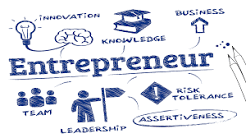
Starting and growing a business requires more than having a good idea.
Entrepreneurs must make decisions, understand customers, manage finances, build teams, adapt to changing markets, and create systems that allow a business to operate effectively.
Leadership becomes increasingly important as a company grows.
A founder may initially handle almost everything alone. Over time, however, successful entrepreneurs need to delegate responsibilities, develop employees, establish a strong company culture, and make strategic decisions that move the organization forward.
The combination of entrepreneurship and leadership is therefore essential for building businesses that can survive, adapt, and grow.
This guide explores the most important principles, skills, strategies, and emerging trends that entrepreneurs and business leaders should understand.
What Is Entrepreneurship?
Entrepreneurship is the process of identifying opportunities, developing solutions, taking calculated risks, and creating value through a business or other venture.
Entrepreneurs may:
- Start new companies
- Develop products
- Create services
- Build technology platforms
- Solve customer problems
- Enter new markets
- Transform existing business models
Entrepreneurship is not simply about starting a company.
It is fundamentally about creating value and solving meaningful problems.
What Is Leadership?
Leadership is the ability to guide people toward a shared objective.
Effective leaders help organizations:
- Establish direction
- Make decisions
- Develop talent
- Solve problems
- Communicate expectations
- Manage change
- Build trust
Leadership does not necessarily depend on having a formal management position.
A person can demonstrate leadership by taking responsibility, helping others succeed, and influencing positive outcomes.
Entrepreneurship vs. Leadership
Entrepreneurship and leadership are closely related but not identical.
Entrepreneurship focuses heavily on identifying opportunities and creating value.
Leadership focuses on guiding people and organizations toward achieving goals.
An entrepreneur may create an excellent business idea, but leadership skills are often necessary to turn that idea into a sustainable organization.
Why Leadership Matters to Entrepreneurs
Many businesses begin with a single founder or a small team.
As the organization grows, complexity increases.
There may be:
- More employees
- More customers
- More responsibilities
- Larger budgets
- More competitors
- More operational challenges
At this stage, entrepreneurs must transition from doing everything themselves to building systems and empowering other people.
1. Start With a Clear Vision
A strong business needs a clear direction.
A vision describes what the organization wants to achieve over the long term.
A useful vision should answer:
- What problem are we solving?
- Who are we helping?
- Why does the business exist?
- What do we want to become?
A clear vision can help employees understand how their work contributes to a larger goal.
2. Identify a Real Customer Problem
One of the most common entrepreneurial mistakes is starting with a product rather than a problem.
Instead of asking:
“What can I build?”
Entrepreneurs should ask:
“What problem do customers need solved?”
Businesses are more likely to succeed when their products or services address genuine customer needs.
3. Understand Your Target Market
Entrepreneurs should understand who their ideal customers are.
Research can include:
- Customer demographics
- Buying behavior
- Competitors
- Market size
- Customer preferences
- Pain points
- Pricing expectations
The goal is not to appeal to everyone.
A clearly defined target audience can make marketing, product development, and sales more focused.
4. Develop a Strong Value Proposition
A value proposition explains why customers should choose your product or service.
It should communicate:
- The problem you solve
- Who you serve
- The benefit you provide
- What makes your solution different
A strong value proposition is usually clear and easy to understand.
5. Validate Your Business Idea
Entrepreneurs do not need to build an entire product before testing whether customers want it.
Validation can involve:
- Customer interviews
- Surveys
- Landing pages
- Prototypes
- Demonstrations
- Pre-orders
- Small pilot programs
Early feedback can reveal whether an idea needs improvement before significant resources are invested.
6. Build a Minimum Viable Product
A Minimum Viable Product (MVP) is a basic version of a product designed to test important assumptions.
The purpose is not to create an incomplete product forever.
The purpose is to learn quickly.
A typical cycle is:
Build → Measure → Learn → Improve
This approach can help entrepreneurs reduce unnecessary development and respond to customer feedback.
7. Develop Financial Discipline
Revenue does not automatically mean a business is financially healthy.
Entrepreneurs need to understand:
- Revenue
- Expenses
- Profit
- Cash flow
- Customer acquisition costs
- Pricing
- Margins
- Taxes
Cash-flow problems can damage businesses even when sales appear strong.
Financial discipline should therefore begin early.
8. Understand Cash Flow
Cash flow describes money moving into and out of a business.
Entrepreneurs should monitor:
Money received − Money spent = Net cash flow
Businesses should also understand when payments are expected and when expenses must be paid.
Good cash-flow management can help businesses survive unexpected challenges.
9. Build a Sustainable Business Model
A business model explains how a company creates and captures value.
Important questions include:
- Who pays?
- What are they paying for?
- How often do they pay?
- What does it cost to serve them?
- How can the business grow?
Common models include:
- Subscription
- E-commerce
- Advertising
- Marketplace
- Licensing
- Consulting
- Freemium
- Transaction fees
10. Learn to Make Decisions Under Uncertainty
Entrepreneurs rarely have perfect information.
They may need to decide:
- Whether to hire
- Which product to launch
- How much to spend
- Which market to enter
- Whether to raise funding
Strong leaders do not wait for complete certainty.
Instead, they gather relevant information, assess risks, make informed decisions, and adjust when new evidence appears.
11. Take Calculated Risks
Entrepreneurship involves risk.
However, successful entrepreneurs generally distinguish between:
Calculated risk and reckless risk.
Before making a major decision, consider:
- Potential benefit
- Potential loss
- Probability of failure
- Available resources
- Alternative options
- Ability to recover
The objective is not to eliminate risk.
It is to manage it intelligently.
12. Build Strong Communication Skills
Communication is one of the most important leadership skills.
Entrepreneurs communicate with:
- Employees
- Customers
- Investors
- Partners
- Suppliers
- Advisors
Strong communication should be:
- Clear
- Direct
- Respectful
- Consistent
- Appropriate for the audience
Poor communication can create confusion even when the underlying strategy is strong.
13. Learn to Delegate
Many entrepreneurs struggle with delegation.
They may believe:
“It will be faster if I do it myself.”
That may be true in the short term.
But a business cannot scale if the founder must personally handle every important task.
Effective delegation involves:
- Choosing the right person.
- Explaining the expected outcome.
- Providing appropriate resources.
- Establishing deadlines.
- Allowing ownership.
- Reviewing results.
Delegation is not simply giving someone more work.
It is transferring responsibility with appropriate authority.
14. Build a Strong Team
A business is ultimately operated by people.
When hiring, entrepreneurs should consider:
- Skills
- Experience
- Problem-solving ability
- Communication
- Adaptability
- Cultural contribution
Technical ability matters, but attitude and willingness to learn can also be valuable.
15. Create a Healthy Company Culture
Company culture influences how employees interact and make decisions.
A healthy culture can encourage:
- Trust
- Accountability
- Collaboration
- Learning
- Respect
- Innovation
Culture should not exist only as a statement on a company website.
Leadership behavior must reinforce it every day.
16. Lead by Example
Employees often pay attention to what leaders do rather than what they say.
If leaders expect:
- Punctuality
- Accountability
- Honesty
- Customer focus
- Continuous improvement
they should demonstrate these behaviors themselves.
Leadership credibility grows when actions match expectations.
17. Develop Emotional Intelligence
Emotional intelligence involves understanding and managing emotions while effectively responding to other people’s emotions.
Important areas include:
- Self-awareness
- Empathy
- Self-control
- Communication
- Relationship management
Entrepreneurs frequently operate under pressure.
Emotional intelligence can help leaders manage difficult conversations and maintain productive relationships.
18. Learn From Failure
Failure is a normal part of entrepreneurship.
A failed product, marketing campaign, or business experiment can provide valuable information.
Instead of asking:
“Who is responsible for this failure?”
strong leaders may ask:
“What happened, why did it happen, and what should we change?”
The goal is to turn setbacks into learning opportunities.
19. Encourage Innovation
Innovation does not always mean creating revolutionary technology.
It can involve:
- Improving a process
- Reducing costs
- Simplifying a product
- Improving customer service
- Finding a new market
- Automating repetitive work
Small improvements can create significant advantages over time.
20. Use Technology Strategically
Modern businesses have access to technologies that can improve operations.
Examples include:
- Cloud software
- Customer relationship management systems
- Artificial intelligence
- Business analytics
- Automation
- Collaboration platforms
- Digital payment systems
Technology should solve a business problem rather than being adopted simply because it is popular.
21. Use AI in Business
Artificial intelligence is increasingly becoming an entrepreneurial tool.
Businesses can use AI for:
- Customer support
- Marketing
- Data analysis
- Content creation
- Research
- Sales assistance
- Workflow automation
- Software development
However, organizations should establish appropriate controls around accuracy, privacy, security, and human oversight.
22. Automate Repetitive Tasks
Automation can free employees from repetitive administrative work.
Examples include:
- Invoice processing
- Appointment scheduling
- Customer notifications
- Data entry
- Lead routing
- Report generation
The best automation opportunities are usually repetitive, predictable processes with clear rules.
23. Understand Customer Experience
A strong product can still fail if the customer experience is poor.
Entrepreneurs should evaluate the complete customer journey:
Discovery → Purchase → Onboarding → Usage → Support → Retention
Every stage creates an opportunity to improve customer satisfaction.
24. Listen to Customers
Customer feedback can reveal problems that internal teams may overlook.
Businesses can collect feedback through:
- Surveys
- Reviews
- Interviews
- Support conversations
- Product analytics
- Social media
The important part is not simply collecting feedback.
Businesses need to identify patterns and act on useful insights.
25. Build Customer Loyalty
Acquiring customers can be expensive.
Retaining satisfied customers can therefore be extremely valuable.
Businesses can improve retention through:
- Reliable products
- Good support
- Personalization
- Loyalty programs
- Useful communication
- Continuous improvement
Trust is one of the strongest foundations of customer loyalty.
26. Develop Strong Marketing Skills
Entrepreneurs do not necessarily need to become professional marketers, but they should understand the fundamentals.
Important areas include:
- Positioning
- Branding
- Content marketing
- Search engine optimization
- Social media
- Email marketing
- Paid advertising
- Referral marketing
Marketing should communicate value rather than simply promote features.
27. Build a Personal Brand
For many entrepreneurs, the founder’s reputation influences the company’s growth.
A personal brand can help establish:
- Expertise
- Trust
- Authority
- Industry relationships
Entrepreneurs can build personal brands through:
- Articles
- Videos
- Podcasts
- Speaking
- Social media
- Industry communities
Authenticity is more sustainable than trying to imitate another entrepreneur.
28. Network Strategically
Relationships can create opportunities for:
- Partnerships
- Customers
- Mentorship
- Hiring
- Investment
- Knowledge sharing
Effective networking is not simply collecting contacts.
It is about building mutually valuable relationships.
29. Find Mentors and Advisors
Entrepreneurs do not need to solve every problem alone.
Experienced mentors can provide perspective on:
- Strategy
- Hiring
- Finance
- Marketing
- Leadership
- Expansion
The best mentors do not simply provide answers.
They help entrepreneurs think more effectively.
30. Manage Time Effectively
Entrepreneurs often face dozens of competing priorities.
Effective leaders distinguish between:
Urgent tasks and important tasks.
A useful approach is to prioritize work based on:
- Business impact
- Urgency
- Strategic importance
- Effort required
Delegation and automation can also reduce unnecessary workload.
31. Focus on High-Impact Activities
Not every task contributes equally to business growth.
Entrepreneurs should regularly ask:
“What activity creates the most value right now?”
This could be:
- Improving the product
- Closing important sales
- Hiring key employees
- Fixing customer problems
- Developing partnerships
Focus allows limited resources to produce greater results.
32. Manage Business Growth Carefully
Growth sounds positive, but uncontrolled growth can create problems.
A rapidly growing company may experience:
- Cash-flow pressure
- Hiring problems
- Customer-service issues
- Operational complexity
- Quality problems
Businesses should build systems before growth creates unnecessary chaos.
33. Develop Standard Operating Procedures
Standard Operating Procedures, or SOPs, document how recurring tasks should be performed.
SOPs can help with:
- Employee training
- Quality control
- Delegation
- Consistency
- Business continuity
They are especially valuable when a company grows beyond its founding team.
34. Measure Business Performance
Entrepreneurs should use meaningful metrics to understand whether the business is improving.
Depending on the business, useful metrics may include:
- Revenue
- Profit margin
- Customer acquisition cost
- Customer lifetime value
- Conversion rate
- Retention rate
- Churn
- Average order value
Metrics should support decisions rather than become numbers that nobody uses.
35. Learn From Data
Data can help entrepreneurs identify:
- Customer behavior
- Product problems
- Marketing performance
- Sales trends
- Operational inefficiencies
However, data should be interpreted within context.
A metric can show what is happening without automatically explaining why it is happening.
36. Build Resilience
Business environments can change unexpectedly.
Entrepreneurs may face:
- Economic downturns
- New competitors
- Supply problems
- Technology changes
- Regulatory changes
- Customer behavior shifts
Resilient businesses maintain flexibility and avoid depending too heavily on a single assumption.
37. Adapt to Market Changes
Successful entrepreneurs continuously monitor their environment.
They should pay attention to:
- Customer needs
- Competitors
- Technology
- Regulations
- Economic conditions
- Industry trends
Adaptation does not mean chasing every trend.
It means recognizing meaningful changes early enough to respond.
38. Ethical Leadership
Leadership should not be measured solely by financial performance.
Ethical leaders consider the effects of business decisions on:
- Employees
- Customers
- Partners
- Communities
- The environment
Trust can become a significant competitive advantage.
39. Transparency Builds Trust
Leaders should communicate honestly when problems occur.
Attempting to hide mistakes can damage trust more than acknowledging them.
Transparent communication can help organizations respond constructively to difficult situations.
40. The Future of Entrepreneurship and Leadership
Entrepreneurship is being reshaped by technology.
Several trends are likely to influence future business leaders.
AI-Powered Entrepreneurship
AI can lower the cost of research, content creation, customer service, software development, and automation.
Remote Entrepreneurship
Entrepreneurs can increasingly build companies with geographically distributed teams.
Creator Entrepreneurship
Individuals can build businesses around audiences, expertise, communities, and digital products.
Automation-First Businesses
Small teams may accomplish more by automating repetitive processes.
Data-Driven Leadership
Leaders will increasingly rely on real-time analytics to understand customers and operations.
The Rise of the AI-Augmented Entrepreneur
AI may allow small teams to perform work that previously required much larger organizations.
An entrepreneur might use AI to assist with:
- Market research
- Business planning
- Content creation
- Customer support
- Data analysis
- Software development
- Workflow automation
This does not eliminate the need for leadership.
Instead, it increases the importance of knowing what should be automated and what requires human judgment.
Leadership in the Age of AI
Leaders will increasingly need to answer questions such as:
- Which tasks should be automated?
- Which decisions require human oversight?
- How should employees use AI?
- How should customer data be protected?
- How should AI-generated work be evaluated?
- What new skills do employees need?
The strongest leaders will likely combine technological understanding with strong human skills.
Skills Every Modern Entrepreneur Should Develop
A well-rounded entrepreneur should continuously improve in:
Strategic Thinking
Understand the bigger picture.
Communication
Explain ideas clearly.
Financial Literacy
Understand the economics of the business.
Sales
Learn how to communicate value and close opportunities.
Marketing
Understand how customers discover products.
Leadership
Help other people perform at their best.
Technology
Understand how modern tools can improve the business.
Adaptability
Respond effectively when circumstances change.
Problem Solving
Break complex problems into manageable parts.
Emotional Intelligence
Understand people and manage relationships effectively.
A Practical Entrepreneurship and Leadership Framework
Entrepreneurs can use the following framework when evaluating a new business opportunity:
Step 1: Identify a Problem
Find a meaningful customer problem.
Step 2: Research the Market
Understand customers and competitors.
Step 3: Define the Solution
Create a clear value proposition.
Step 4: Test the Idea
Validate assumptions with real customers.
Step 5: Build a Simple Version
Create an MVP where appropriate.
Step 6: Measure Results
Track meaningful business metrics.
Step 7: Improve
Use customer and performance data.
Step 8: Build Systems
Document important processes.
Step 9: Build the Team
Hire and develop people strategically.
Step 10: Scale Carefully
Expand only when the business has a sustainable foundation.
Common Entrepreneurship and Leadership Mistakes
Trying to Do Everything Alone
Founders eventually need to delegate.
Ignoring Customer Feedback
Customers often reveal problems businesses cannot see internally.
Spending Too Early
Unvalidated ideas should not receive unlimited resources.
Hiring Too Quickly
Teams should grow according to actual business needs.
Focusing Only on Revenue
Profitability and cash flow also matter.
Avoiding Difficult Decisions
Delayed decisions can become larger problems.
Ignoring Company Culture
Culture develops whether leaders intentionally create it or not.
Chasing Every Technology Trend
Technology should support strategy rather than replace it.
Failing to Adapt
Markets and customer expectations change.
Entrepreneurship and Leadership Checklist
Before launching or growing a business, consider:
- Is there a genuine customer problem?
- Is the target market clearly defined?
- Is the value proposition easy to understand?
- Has the idea been validated?
- Is the business model sustainable?
- Is cash flow being monitored?
- Are important processes documented?
- Are responsibilities clearly assigned?
- Does the team have the necessary skills?
- Are customers being listened to?
- Are meaningful metrics being tracked?
- Is technology being used strategically?
- Are security and privacy being considered?
- Is the business prepared to adapt?
Conclusion
Entrepreneurship and leadership are deeply connected.
Entrepreneurship creates opportunities, develops solutions, and builds businesses. Leadership transforms those opportunities into organized teams, sustainable systems, and long-term results.
The strongest entrepreneurs are not necessarily the people with the most ideas.
They are often the people who can identify valuable problems, test their assumptions, make informed decisions, build strong teams, learn from failure, and adapt to changing circumstances.
Technology is also changing what entrepreneurs can accomplish.
Artificial intelligence, automation, cloud platforms, digital marketing, analytics, and remote collaboration allow small teams to operate with capabilities that were once available primarily to large organizations.
But technology is only one part of the equation.
Successful businesses still depend on trust, communication, customer understanding, financial discipline, leadership, and strong execution.
The future of entrepreneurship will likely belong to leaders who can combine business judgment, technological awareness, human intelligence, and adaptability.
The objective is not simply to build a company.
It is to build an organization that creates lasting value for customers, employees, and the wider market.
Frequently Asked Questions
What is entrepreneurship?
Entrepreneurship is the process of identifying opportunities, solving problems, creating value, and building a business or venture around a sustainable idea.
Why is leadership important in entrepreneurship?
Leadership helps entrepreneurs build teams, communicate vision, delegate responsibilities, make decisions, manage change, and create an environment where people can perform effectively.
What skills does a successful entrepreneur need?
Important skills include strategic thinking, communication, financial literacy, sales, marketing, leadership, problem-solving, adaptability, technology awareness, and emotional intelligence.
What is the difference between an entrepreneur and a leader?
An entrepreneur focuses heavily on creating opportunities and building ventures, while a leader focuses on guiding people and organizations toward shared goals. Successful founders often need both capabilities.
How can entrepreneurs validate a business idea?
They can use customer interviews, surveys, prototypes, landing pages, pilot programs, demonstrations, and pre-orders to test whether there is genuine demand.
What is an MVP?
An MVP, or Minimum Viable Product, is a basic version of a product designed to test important assumptions and gather feedback before investing heavily in development.
How can AI help entrepreneurs?
AI can assist with research, marketing, customer support, data analysis, content creation, software development, and workflow automation.
Should every business use AI?
Not necessarily. Businesses should adopt AI when it provides a meaningful benefit, such as reducing repetitive work, improving customer service, supporting decision-making, or increasing productivity.
Why is delegation important?
Delegation allows entrepreneurs to distribute responsibilities, develop employees, and focus on higher-value strategic activities instead of handling every task personally.
How can entrepreneurs build strong teams?
Entrepreneurs should hire people with appropriate skills, communicate expectations clearly, establish accountability, encourage learning, and create a healthy workplace culture.
How can entrepreneurs handle failure?
Entrepreneurs can treat failure as a source of information by identifying what went wrong, understanding the underlying causes, adjusting their strategy, and testing improved approaches.
What is ethical leadership?
Ethical leadership involves making decisions based on honesty, accountability, fairness, responsibility, and consideration for the effects of business decisions on stakeholders.


