

The Rise of AI Code Detection Tools in Modern Development
Introduction
In today’s fast-paced software development world, code review teams are experiencing a significant transformation. The emergence of AI assistants, code generators, and large language model (LLM) powered programming tools has revolutionized the way developers write, optimize, and ship code. While these advancements greatly enhance productivity, they also bring forth unique challenges—especially in identifying AI-generated code, ensuring originality, maintaining quality, reducing vulnerabilities, and promoting consistency across large teams.
Now, AI code detection tools have become essential in modern DevSecOps pipelines. These tools help engineering teams verify code authenticity, detect AI-supported patterns, identify vulnerabilities earlier in the process, and minimize human error. By supporting faster, more accurate code reviews, they foster trust and transparency in enterprise software environments.
Importance of AI Code Detection Tools
As organizations increasingly demand clean, secure, and efficient code delivered in shorter timeframes, the traditional manual review process often struggles. Manual reviews might overlook issues, especially in shorter development cycles. Thus, AI code detection tools can be invaluable, offering:
- Improved Accuracy: Better detection of risky patterns and anomalies often missed by humans.
- Faster Identification: Swift discovery of duplicated or suspicious code.
- Enhanced Verification: More robust proof of AI-generated contributions.
- Consistency: Uniform application of coding standards, regardless of who is writing the code.
- Scalable Security: Maintaining security protocols across large codebases.
- Reduced Human Fatigue: Alleviating the burden on developers and reviewers, allowing them to focus on more complex tasks.
A staggering 71% of enterprise developers reportedly utilize some form of AI assistance, making the need for code origin detection and secure AI-backed reviews more critical than ever.
Challenges of Traditional Code Review
Traditional manual code reviews come with drawbacks such as:
- Human Fatigue: Reviewers may miss issues due to tiredness or repetitive tasks.
- Inconsistent Standards: Different reviewers may apply differing standards for code evaluation.
- Time-Consuming Cycles: Lengthy discussions and back-and-forth exchanges can delay project timelines.
- Difficulty in Verifying Originality: Ensuring no part of the code is plagiarized or improperly derived can be challenging.
- Delayed Vulnerability Detection: Identifying vulnerabilities late in the review process can lead to challenges in deployment.
- Limited Visibility: Large monorepos can be overwhelming, making it difficult to maintain oversight.
AI-driven tools effectively address these concerns through automation, objective evaluation, and large-scale pattern analysis.
Enhancing Accuracy, Security, and Code Consistency with AI
AI-powered detection systems offer several key benefits:
- Automated Scanning: Diligently scanning for logic flaws and vulnerabilities without human oversight.
- Uniformity: Applying consistent rules across all code submissions.
- Source Identification: Detecting code produced by AI or copied from external sources.
- Similarity Matching: Comparing code against extensive open-source datasets for better assessment.
- Advanced Static Analysis: Utilizing machine learning models for deeper insights into coding practices.
- Accelerated Review Cycles: Prioritizing issues before a human reviews the code, speeding up the overall review process.
These improvements not only enhance productivity but also bolster the trustworthiness of the code.
Language Specific Challenges
Different programming languages present unique challenges that AI detection tools can tackle effectively:
Python
Due to its dynamic nature, Python can lead to inconsistent formatting and pinpointing hidden bugs can be elusive. AI detectors help identify risky imports and insecure patterns that might get overlooked in a manual review.
Java
Java projects often consist of extensive enterprise codebases where consistency and security matter. AI tools can flag unsafe class structures and improper exception handling, ensuring that coding guidelines are adhered to.
JavaScript
The flexibility of JavaScript can lead to style variations and dependency vulnerabilities. AI detectors highlight unsafe patterns and problematic async logic, allowing teams to rectify issues before they escalate.
Global Usage Insights
AI code detection is becoming a global standard, particularly in:
- USA: Enterprises focus on security and compliance; tools like Checkmarx and CodeQL are favorites.
- UK: Fintech and cybersecurity projects frequently use SonarQube and Semgrep.
- Canada: Stable code and technical debt reduction are priorities, making PVS Studio and SonarQube popular choices.
- UAE: Digital transformation in government relies on secure scanners such as Checkmarx and Fortify.
- India: Large IT outsourcing firms turn to tools like Semgrep and DeepCode to manage substantial development efforts.
- Pakistan: Freelance teams use CodeSpy.ai and Codequiry for consistency and to validate code authenticity.
These regional differences underline the diverse application of these tools based on industry needs and compliance requirements.
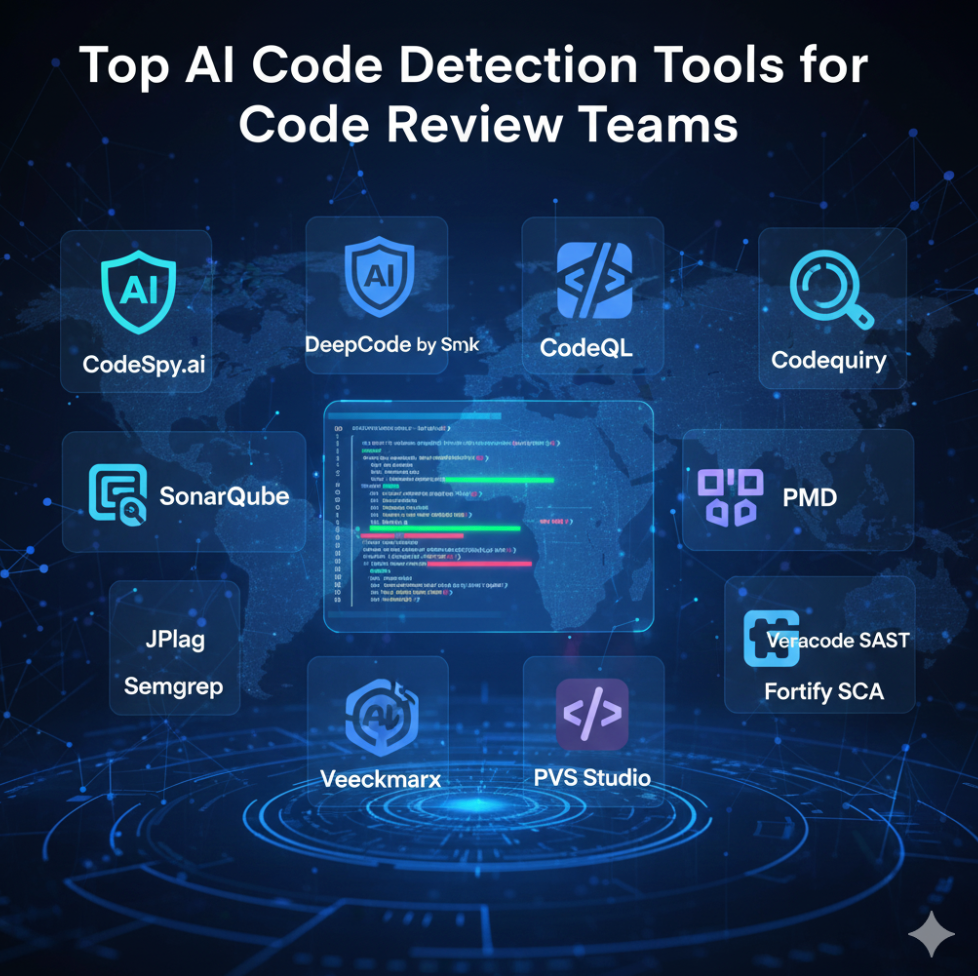
Top AI Code Detection Tools for Code Review Teams
Here are some leading AI code detection tools shaping the landscape in the current year:
1. CodeSpy.ai
This tool is designed to differentiate between AI-generated and human-written code. As the usage of AI assistants rises, understanding code origin becomes crucial. CodeSpy.ai excels with advanced pattern recognition and integrates seamlessly into CI pipelines.
2. DeepCode by Snyk
DeepCode provides vulnerability analysis by leveraging machine learning models trained on real-world examples. Ideal for Java, Python, and JavaScript teams, it integrates smoothly with platforms like GitHub and GitLab to enhance code quality.
3. SonarQube
A widely adopted tool for automated code review, SonarQube evaluates code across over 30 programming languages for best practices and security vulnerabilities. Its real-time metrics make it a staple for enterprises.
4. CodeQL
GitHub’s CodeQL is powerful for querying codebases for vulnerabilities, making it a favorite among security teams seeking custom assessments and remediation.
5. Codequiry
Focusing on plagiarism and code similarity, Codequiry is essential for universities and learning platforms to uphold code integrity.
6. JPlag
An academic-focused tool, JPlag analyzes submissions for structural patterns, making it effective for evaluating originality in educational settings.
7. PMD
PMD is known for identifying common coding mistakes in Java and JavaScript projects. It is a vital asset for teams seeking consistency and clarity.
8. Checkmarx
Designed for enterprise security, Checkmarx employs AI to uncover vulnerabilities across various languages, making it a strong choice for high-compliance environments.
9. Semgrep
Semgrep stands out due to its customizable scanning capabilities, allowing teams to define rules specific to their codebase needs.
10. Veracode SAST
Veracode specializes in enterprise-level security analysis, detecting vulnerabilities and compliance risks.
11. PVS Studio
PVS Studio excels in detecting subtle bugs across multiple languages, supporting teams in enhancing code reliability.
12. Fortify SCA
As a leader in secure code review, Fortify identifies vulnerabilities efficiently while supporting various programming languages.
Tools Comparison Table
Selecting the right AI code detection tool is crucial for organizations. Below is a comparative summary based on functionality, supported languages, and ideal use case:
| Tool | Function | Languages Supported | Key Features | Ideal For |
|---|---|---|---|---|
| CodeSpy.ai | Detect AI vs human code | Python, Java, JavaScript, PHP, C#, C++ | AI detection, pattern recognition, CI integration | Enterprises, global dev teams |
| DeepCode | Vulnerability & quality analysis | Python, Java, JavaScript, C# | AI-powered code review, risk detection | Secure coding, DevSecOps |
| SonarQube | Static analysis & quality monitoring | 30+ languages including Java, Python, JavaScript | Code smells, maintainability metrics | Enterprises, mid-size teams |
| CodeQL | Query-based vulnerability detection | Python, Java, JavaScript, C, C++ | Custom queries, vulnerability hunting | Security teams, enterprises |
| Codequiry | Code similarity & plagiarism detection | Java, Python, JavaScript, C++, C# | AI/ML-based similarity matching | Universities, integrity validation |
| JPlag | Academic code similarity detection | Java, Python, JavaScript, C++, C# | Structural matching, visual comparison | Academic programs, assessment teams |
| PMD | Static analysis | Java, JavaScript, Apex | Syntax checks, style enforcement, unused detection | Java & JS dev teams |
| Checkmarx | Enterprise security & code scanning | Java, Python, JavaScript, C#, others | AI-assisted scanning, CI integration | Enterprises, compliance sectors |
| Semgrep | Pattern matching & code scanning | Python, Java, JavaScript, Go, others | Custom rules, lightweight scanning | Dev teams |
| Veracode SAST | Static application security testing | Java, Python, JavaScript, C, C++ | Vulnerability detection, compliance support | Regulated industries, enterprise |
| PVS Studio | Bug detection & static analysis | C, C++, Java, C# | Error detection, reliability issues | Large-scale codebases |
| Fortify SCA | Enterprise static analysis | Java, Python, JavaScript, C++, C# | Security scanning, detailed remediation guidance | Enterprise DevSecOps |
GEO Based Usage Patterns
USA
Focus lies on security and compliance with a tendency towards using Checkmarx, Fortify, and CodeQL.
UK
Investment is heavily placed on fintech, cybersecurity, and regulatory alignment, with SonarQube, Veracode, and Semgrep leading the charge.
Canada
Software product firms concentrate on stable code with a preference for PVS Studio and SonarQube.
UAE
Digital transformation efforts, especially within government, gravitate towards robust, secure scanners like Checkmarx and Fortify.
India
Large outsourcing firms often utilize Semgrep, SonarQube, and DeepCode to support extensive development efforts.
Pakistan
Software houses and freelance teams rely on authenticity tools like CodeSpy.ai and Codequiry to maintain consistency in their codebases.
Common Mistakes Developers Make Without AI Code Reviewers
Developers can overlook several critical aspects when manual reviews dominate, including:
- Subtle Vulnerabilities: Small flaws can lead to significant exploits.
- Detection of AI Written Code: Missing the identification of AI-generated code may lead to compliance breaches.
- Reused Code: Duplication might remain undetected, causing inefficiencies.
- Insecure Dependencies: Delayed identification can jeopardize security.
- Inconsistent Conventions: Different standards can clutter code quality.
- Slow Review Cycles: Prolonged evaluations delay project timelines.
AI tools streamline efforts by ensuring a thorough, automated evaluation process.
Future Prospects of AI-Powered Code Detection
As we look forward to 2027, the evolution of AI code detectors seems promising. Anticipated advancements include:
- Deeper integration with LLM-based IDEs.
- Real-time verification of code authenticity.
- Predictive capabilities for vulnerabilities before code execution.
- Behavioral analysis of developer coding habits.
- Recommendations for self-healing code.
The embedding of AI detectors within the secure software development framework will likely become standard practice, shaping a more robust coding ecosystem.
FAQ About AI Code Detectors
What is an AI code detection tool?
AI code detection tools analyze source code to find AI-generated content, vulnerabilities, or risky logic patterns using machine learning.
Why do code review teams need AI detectors?
These tools automate complex analyses, catch hidden issues, ensure originality, and speed up the entire review process.
Which tool detects AI-generated code?
CodeSpy.ai specifically focuses on discerning whether code originates from AI or human authors.
Which countries use these tools the most?
The USA, UK, Canada, UAE, India, and Pakistan are leading adopters as per recent industry reports.
Can AI detectors replace human reviewers?
No, they are meant to complement humans by automating initial checks and highlighting priority issues.
With the landscape of software development continually evolving, AI code detection tools are indispensable for teams striving for excellence and security in their code. Their integration fosters an environment of trust and efficiency, ensuring the delivery of high-quality software solutions.