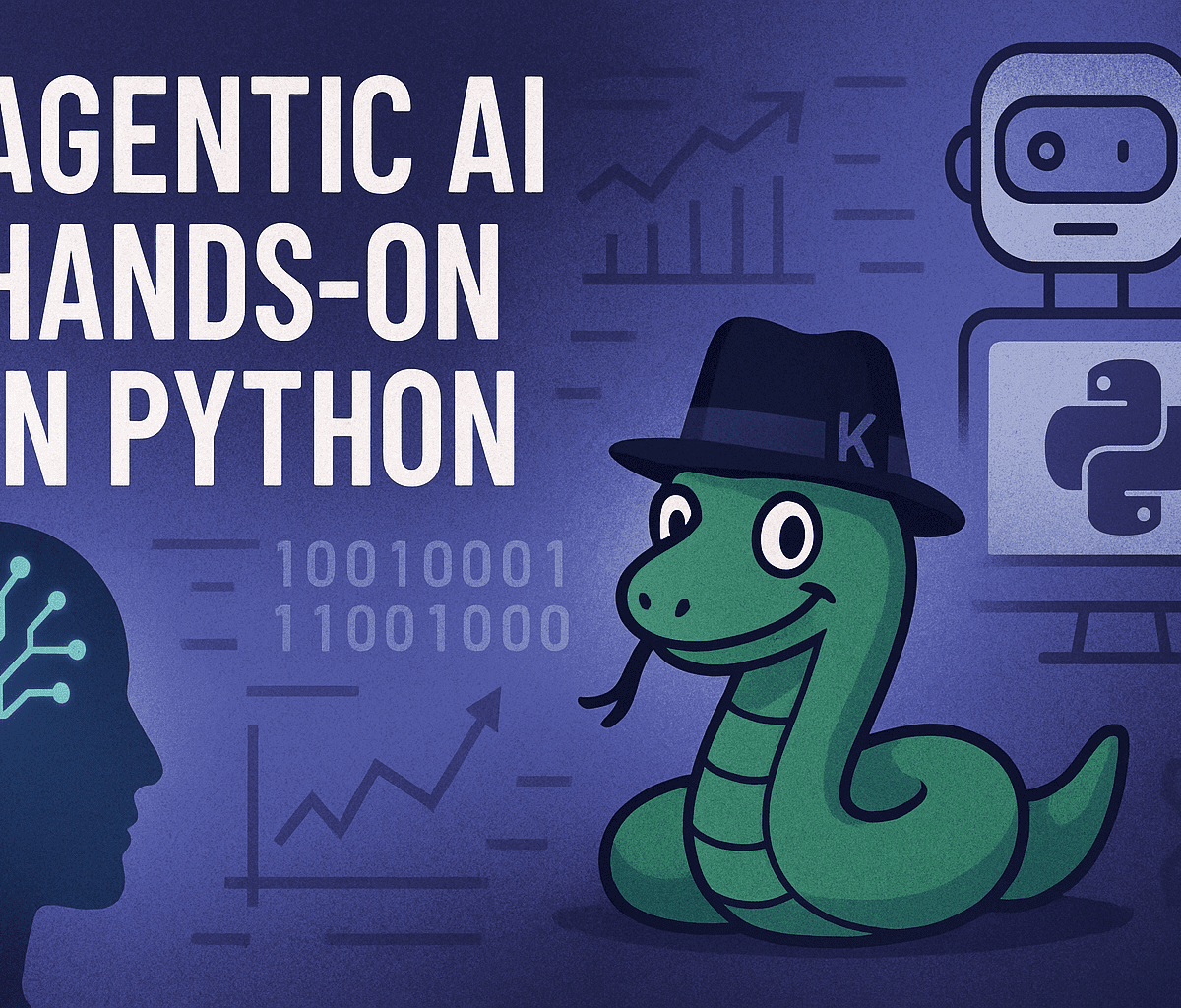

Image by Editor | ChatGPT
# Introduction
Agentic AI might sound like a term lifted straight from a sci-fi novel, yet it’s a rapidly evolving concept that is reshaping the landscape of artificial intelligence. At its core, agentic AI can be thought of as an AI that embraces a new level of autonomy—acting, learning, and adapting in ways that go beyond traditional predefined responses. Imagine AI that thinks on its feet, akin to a jazz musician improvising a solo—where the possibilities are dictated by the interaction between the AI and its environment.
No longer do we have to navigate this abstract concept alone; an enlightening four-hour workshop hosted by Jon Krohn and Edward Donner offers a comprehensive guide into the world of agentic AI. Recorded during an ODSC talk, this workshop delivers practical insights into the design and engineering of AI agents, setting the foundation for their widespread application in the business landscape of 2025 and beyond.
# What’s Covered?
The workshop dives deep, breaking down a variety of topics essential for anyone looking to become proficient in agentic AI:
- Defining Agents: At the heart of the discussion is the definition of AI agents, characterized as advanced programs where LLM outputs drive complex workflows. This distinction highlights a shift from simpler, predefined workflows to more dynamic, adaptive agents capable of operating autonomously.
- The Case for Agentic AI: A detailed exploration affirms the unprecedented opportunity for businesses to gain value from agentic workflows in 2025, underpinned by rapid improvements in LLM capabilities and their impact on benchmarks such as Humanity’s Last Exam (HLE).
- Foundational Elements: The workshop lays out essential components, emphasizing tools that empower LLMs and discussing potential risks like unpredictability and cost management. Strategies for monitoring and implementing guardrails are integral to ensuring successful deployments.
- Implications of Agentic AI: Addressing the shifting landscape, the session discusses workforce dynamics and future-proofing careers in data science. Skills like multi-agent orchestration and foundational knowledge become crucial as the landscape evolves.
# Agentic AI Frameworks
The technological underpinnings that facilitate the agentic revolution are also highlighted:
- Model Context Protocol (MCP): An open-source standard protocol designed to connect agents with data sources and tools, akin to a universal connector for agentic applications.
- OpenAI Agents SDK: A lightweight, flexible framework ideal for deep research into agentic AI applications.
- CrewAI: A robust framework tailored for multi-agent systems, designed to streamline collaboration among various agents.
- Additionally, more complex frameworks like LangGraph and Microsoft Autogen are reviewed, emphasizing their specialized capabilities.
# Practical Exercises
Hands-on experience is integral to this workshop, featuring coding exercises that illustrate the practical aspects of agentic AI development:
- Participants are guided through recreating OpenAI’s Deep Research functionality using the OpenAI Agents SDK. This exercise demonstrates the power of agents in executing web searches and generating comprehensive reports.
- Design principles for agentic systems are discussed, focusing on five critical workflow design patterns: Prompt Chaining, Routing, Parallelization, Orchestrator Worker, and Evaluator Optimizer, providing a structured framework for execution.
- A demonstration of building an autonomous software engineering team with CrewAI showcases agents collaborating to write, test Python code, and even generate user interfaces—a testament to CrewAI’s comprehensive features.
- The workshop culminates in an ambitious project: developing autonomous traders using MCP. This segment highlights how agents can harness real-time market data and persistent knowledge graphs to make informed trading decisions.
# Expected Takeaways
By the end of the workshop, viewers can expect to have gained:
- A solid grasp of AI agents, including their definitions, core components like tools, and distinguishing features that set dynamic systems apart from static setups.
- Hands-on experience implementing agentic systems with popular frameworks, enhancing skills in multi-agent collaboration and leveraging innovative features.
- An understanding of the Model Context Protocol (MCP) for effectively integrating diverse tools and resources into agentic applications, including constructing basic custom MCP servers.
- The ability to develop practical agentic applications, rooted in the workshop exercises, and skills in projects such as autonomous software engineering teams and simulated trading agents.
- A framework for recognizing risks associated with deploying agentic systems and implementing mitigation strategies through monitoring and guardrails.
If you desire clarity on agentic AI and want to harness the incredible potential of this burgeoning technology in your AI engineering endeavors, the workshop offered by Jon Krohn and Edward Donner is an invaluable resource.
Matthew Mayo (@mattmayo13) holds a master’s degree in computer science and a graduate diploma in data mining. As managing editor of KDnuggets & Statology, and contributing editor at Machine Learning Mastery, Matthew aims to make complex data science concepts accessible. His professional interests include natural language processing, language models, machine learning algorithms, and exploring emerging AI. He is driven by a mission to democratize knowledge in the data science community. Matthew has been coding since he was 6 years old.