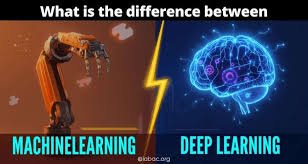
Artificial Intelligence (AI) is transforming industries worldwide, but at the core of this revolution lie two powerful technologies: Machine Learning (ML) and Deep Learning (DL). These systems enable computers to learn from data, identify patterns, and make decisions without explicit programming.
From voice assistants and recommendation engines to medical diagnostics and autonomous vehicles, ML and DL power many of today’s most advanced technologies.
In this comprehensive guide, we’ll explore how machine learning and deep learning work, how they differ, real-world applications, and what the future holds.
What Is Machine Learning?
Machine Learning is a branch of AI that allows systems to learn from data and improve performance over time without being explicitly programmed.
Instead of writing rules manually, developers train models using datasets so the system can recognize patterns and make predictions.
Simple Example:
An email spam filter learns to detect spam messages by analyzing thousands of emails and identifying patterns common in spam content.
Types of Machine Learning
1️⃣ Supervised Learning
The model is trained using labeled data.
Examples:
- Spam detection
- Price prediction
- Image classification
2️⃣ Unsupervised Learning
The system finds patterns without labeled data.
Examples:
- Customer segmentation
- Fraud detection
- Data clustering
3️⃣ Reinforcement Learning
The system learns through rewards and penalties.
Examples:
- Robotics
- Game AI
- Autonomous navigation
What Is Deep Learning?
Deep Learning is a specialized subset of machine learning that uses neural networks with multiple layers to analyze complex data.
These neural networks are inspired by how the human brain processes information.
Companies like Google DeepMind and OpenAI use deep learning to build advanced AI systems capable of language understanding, image recognition, and problem solving.
How Deep Learning Works
Deep learning models process data through layers of artificial neurons:
Input Layer → Hidden Layers → Output Layer
Each layer extracts increasingly complex features from the data.
Example:
- First layer detects edges in an image
- Second layer detects shapes
- Third layer recognizes objects
This layered learning allows deep learning models to handle complex tasks.
Machine Learning vs Deep Learning
| Feature | Machine Learning | Deep Learning |
|---|---|---|
| Data Requirement | Moderate | Very large |
| Hardware Needs | Standard | High-performance GPUs |
| Complexity | Lower | Higher |
| Accuracy | Good | Very high for complex tasks |
| Training Time | Shorter | Longer |
Deep learning excels when massive datasets and computing power are available.
Real-World Applications
🧠 Healthcare
- Disease diagnosis
- Medical image analysis
- Drug discovery
💰 Finance
- Fraud detection
- Risk analysis
- Algorithmic trading
🛍 Retail & Marketing
- Recommendation systems
- Customer behavior prediction
- Dynamic pricing
🚗 Transportation
- Autonomous vehicles
- Traffic prediction
- Route optimization
🎤 Voice & Language
- Speech recognition
- Language translation
- Chatbots
These technologies power many modern digital experiences.
Benefits of Machine Learning & Deep Learning
✅ Automation
Reduces manual tasks and increases efficiency.
✅ Predictive Insights
Helps organizations anticipate trends and risks.
✅ Personalization
Improves user experiences through tailored recommendations.
✅ Scalability
Handles massive datasets faster than humans.
Challenges and Limitations
Despite their power, ML and DL systems face challenges:
⚠️ Data Dependency
Models require large, high-quality datasets.
⚠️ Bias Risk
Biased training data leads to biased predictions.
⚠️ High Computational Cost
Deep learning models require significant processing power.
⚠️ Interpretability Issues
Some models act as “black boxes,” making decisions hard to explain.
Responsible development is essential.
Tools & Frameworks Used in ML/DL
Developers commonly use frameworks such as:
- TensorFlow
- PyTorch
- Scikit-learn
- Keras
These tools simplify model building, training, and deployment.
Future Trends in Machine Learning & Deep Learning
🚀 Automated Machine Learning (AutoML)
Systems that build models automatically with minimal human input.
🤖 Edge AI
Running models directly on devices rather than cloud servers.
🧩 Multimodal Learning
Models capable of understanding text, images, audio, and video simultaneously.
🔐 Privacy-Preserving AI
Techniques like federated learning that protect user data.
How Businesses Can Use ML & DL
Organizations can leverage machine learning to:
- Improve customer insights
- Optimize operations
- Detect fraud
- Predict demand
- Automate workflows
Companies that adopt AI-driven analytics gain competitive advantages.
Beginner Roadmap to Learning ML & DL
If you want to learn these technologies:
- Learn Python programming
- Study statistics and linear algebra
- Understand basic ML algorithms
- Practice with datasets
- Explore neural networks
- Build real projects
Hands-on practice is the fastest way to master ML.
Final Thoughts
Machine learning and deep learning are driving the most significant technological transformations of our time. They enable computers to learn, adapt, and make intelligent decisions — reshaping industries from healthcare to finance.
As data continues to grow and computing power improves, these technologies will become even more powerful, accessible, and integrated into everyday life.
Understanding ML and DL today means understanding the future of technology.
SEO FAQs
Q: What is the difference between machine learning and deep learning?
Machine learning is a broad field of AI, while deep learning is a specialized subset that uses neural networks.
Q: Is deep learning better than machine learning?
Deep learning performs better for complex tasks, but machine learning can be more efficient for simpler problems.
Q: Do you need coding skills for machine learning?
Yes, programming skills — especially Python — are typically required.
Q: Why is deep learning powerful?
Because it can automatically learn complex patterns from large datasets.