The Bottlenecks of Traditional Drug Discovery
Despite the advancements in technology and methodologies over decades, the early stages of drug discovery continue to present significant challenges for pharmaceutical research and development (R&D). Traditional approaches primarily rely on extensive screening of existing chemical libraries and established scaffolds. Rather than innovatively discovering solutions tailored to specific projects, these methods focus on optimizing what is already known. This methodology results in an expensive, sluggish, and uncertain drug discovery process—the numbers speak for themselves: only half of discovery programs make it to preclinical development, and the costs associated with these efforts double approximately every nine years.
Introducing Variational AI and Enki
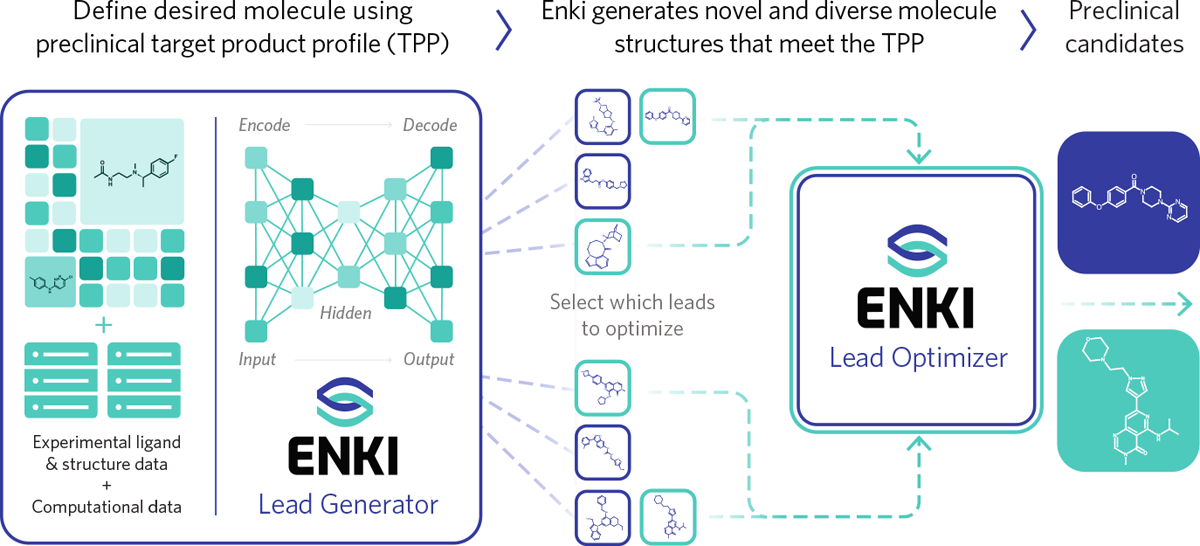
Enter Variational AI, a Vancouver-based startup that is fundamentally reshaping the landscape of drug discovery through generative artificial intelligence (AI). Their technology, Enki, represents a paradigm shift from traditional screening to innovative generation. Enki is a generative AI foundation model crafted specifically to discover and refine novel small molecules. Unlike conventional methods, Enki ventures into the uncharted territories of chemical space, proposing new chemical structures that meet specific biological and pharmacological criteria for therapeutic efficacy.
Enki: A Purpose-Built Solution
What sets Enki apart is its targeted approach to small-molecule drug discovery. The AI has been trained on vast datasets containing millions of data points, including curated molecular structures and bioactivity profiles for more than 700 drug targets. This training enables Enki to identify the characteristics that delineate a successful drug molecule. It can propose structures that traditional experimental methods would be unlikely to yield, producing a variety of first-in-class and best-in-class compounds that are not just innovative, but also feasible for synthesis.
Navigating Chemical Space Like Never Before
Traditionally, discriminative AI algorithms used in drug discovery ranked large libraries of virtual molecules and made incremental improvements to identified leads. In contrast, Enki navigates untapped regions of the chemical space with remarkable speed and accuracy. It generates lead-like compounds designed to meet a particular target product profile (TPP) often in mere days. The AI optimizes these molecules across more than 50 crucial properties, including potency, selectivity, toxicity, and the pharmacokinetics (PK) associated with absorption, distribution, metabolism, and excretion (ADME). This efficiency significantly reduces the number of iteration cycles needed to refine compounds.
A Revolutionary Approach to Drug Design
"Rather than screening and testing more and more compounds, Enki generates better molecules from the start—a radical change for small-molecule drug discovery," Peter Guzzo, executive VP and head of drug discovery at Variational AI, explains. The platform requires only a well-defined preclinical TPP as its input and subsequently proposes optimized lead structures based on efficacy, selectivity, and feasibility of synthesis.
Moreover, Enki is adept at multi-parametric lead optimization, allowing rapid enhancements across various objectives while adhering to fixed structural constraints. Through active learning, Enki supports research teams in achieving significant progress with each cycle, drastically minimizing the typical design-make-test-analyze iteration paradigm.
Real-World Success Stories
Variational AI has implemented Enki in real-world drug discovery collaborations, working closely with major pharmaceutical and biotechnology companies in fields like oncology, dermatology, and rare diseases. These partnerships have proven fruitful, with Enki consistently delivering potent leads that significantly cut the time and costs associated with reaching preclinical candidates.
For instance, Rakovina Therapeutics, a company based in Vancouver, utilized Enki to hasten the discovery of brain-penetrant ataxia telangiectasia and Rad3-related protein (ATR) inhibitors for oncology applications. Similar collaboration successes have also been noted with Merck, ImmVue Therapeutics, and other undisclosed biopharma entities, all achieving remarkable outcomes with Enki in generating high-quality leads before engaging in lead-optimization endeavors.
Pioneering the Future of Drug Discovery
"By using Enki to circumvent the limitations of traditional screening or structure-based design, drug developers can rapidly explore the uncharted chemical space," Handol Kim, CEO of Variational AI, asserts. This expedited exploration not only de-risks the discovery process but also accelerates the progression of early-stage programs.
Continuously enhancing its capabilities, Variational AI releases a new version of Enki every quarter, ensuring that partners have access to cutting-edge and rapidly evolving technologies in generative drug design. “Whether companies are starting a new program with complex targets or tackling hurdles in lead optimization, Enki can unlock innovative chemistry that surpasses conventional methodologies,” Kim adds.
By redefining the economic framework of drug discovery, Enki offers a promising pathway for delivering novel therapeutics to patients more efficiently and effectively.