Understanding Stochastic Rounding: A Nuanced Approach in Numerical Computations
The Fundamentals of Stochastic Rounding
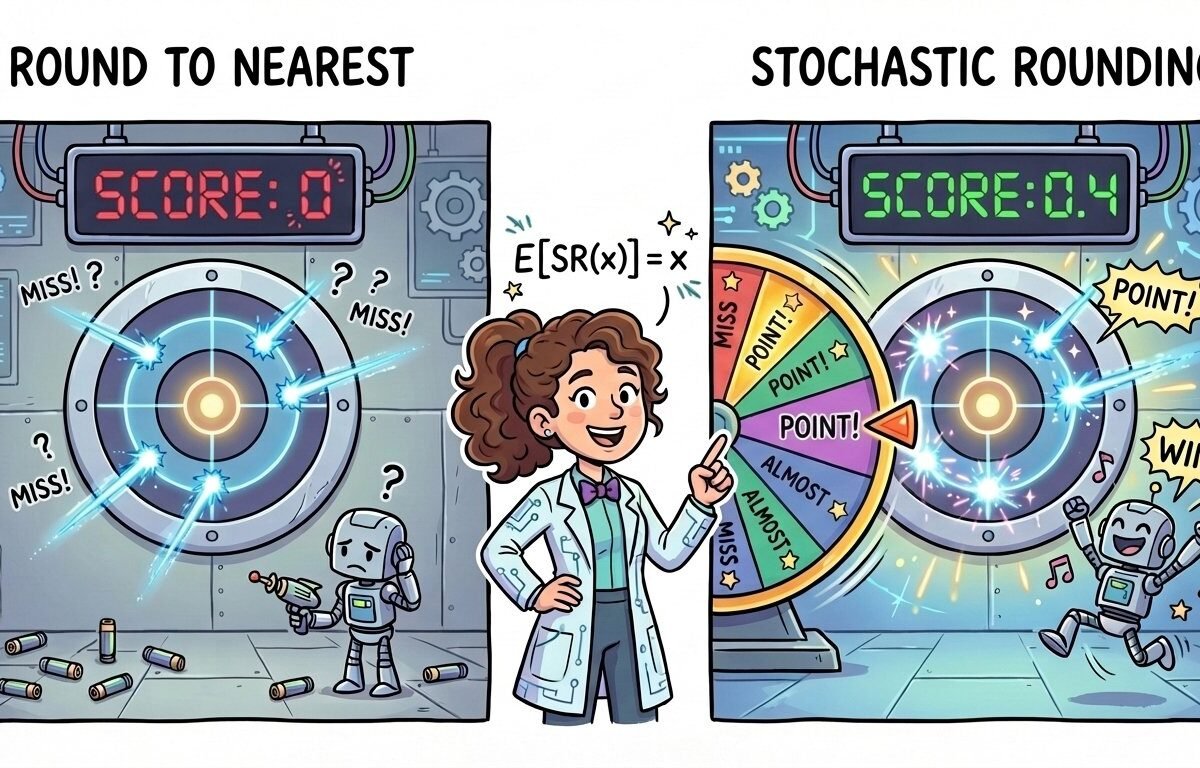
Stochastic rounding (SR) distinguishes itself in computations that require rounding through its unbiased expectation property. Unlike traditional methods like deterministic rounding (RTN)—which consistently rounds to the nearest whole number—SR introduces an element of randomness. This randomness, far from being a flaw, serves a purpose: it allows for more nuanced and robust computations, especially relevant in fields like deep learning.
To illustrate this difference, let’s revisit a simple example. Say we are rounding the number 1.4. In deterministic rounding, we would systematically round down to 1 every single time, resulting in zero variance and stable outputs. However, this comes at a cost—the method is consistently wrong for numbers like 1.4. Stochastic rounding, on the other hand, might yield outputs such as 1, 1, 2, 1, 2, creating a stream of values that fluctuate around the true average, maintaining an overall expectation of 1.4. Here, the individual values may be noisy, but the averaged result remains accurate.
Variance and Systematic Error: A Closer Look
Mathematically, we can analyze the behavior of stochastic rounding using the variance formula:
[
\text{Var(SR}(x)\text{)} = p(1-p)
]
Where ( p = x – \lfloor x \rfloor ). This illustrates that while SR introduces noise in calculations, it retains an essential property—its unbiased nature.
In contrast, deterministic rounding exhibits zero variance but suffers from rapid error accumulation. In a series of ( N ) operations, the systematic error of RTN can rise linearly, represented as ( O(N) ). For instance, if one consistently rounds down by even a minuscule amount, these errors can add up swiftly, leading to significant discrepancies in outcomes.
Stochastic rounding mitigates this issue. The random and unbiased errors generated tend to cancel each other out, which leads to a different error growth rate—specifically, ( O(\sqrt{N}) ). This means that even as the number of operations increases, the total error grows at a much slower rate than that of deterministic rounding.
The Benefits of Noise in Deep Learning
While stochastic rounding introduces variance, this noise can often have a beneficial impact, particularly in the realm of deep learning. The added randomness functions similarly to techniques like dropout, where neurons are randomly ignored during training to enhance network robustness. This implicit regularization helps models explore a broader spectrum of solutions, allowing them to escape shallow local minima and ultimately improve generalization.
Implementing Stochastic Rounding on Google Cloud
The robust performance of stochastic rounding is further amplified by its support on major cloud platforms. Google Cloud, for instance, has integrated this rounding technique into its latest AI accelerators, such as Cloud TPUs and NVIDIA Blackwell GPUs. These accelerators can be employed within AI-optimized Google Kubernetes Engine clusters, allowing for scalable solutions that leverage the advantages of stochastic rounding.
Native Hardware Support in TPUs
Notably, Google’s TPU architecture includes dedicated hardware support for stochastic rounding within its Matrix Multiply Unit (MXU). This dedicated support enables the training of models in lower-precision formats such as INT4, INT8, and FP8 without compromising on performance.
For developers looking to integrate these capabilities, Google offers the Qwix library, a quantization toolkit for JAX that facilitates both Quantization-Aware Training (QAT) and Post-Training Quantization (PTQ). For instance, when preparing a model for INT8 quantization, one could enable stochastic rounding specifically during the backward pass to prevent vanishing gradients, hence improving training efficacy.
Summary of Operational Advantages
In summary, stochastic rounding serves as an innovative strategy that balances precision and performance across various computational tasks. Its ability to negate systematic errors while introducing beneficial noise makes it a highly valuable tool in deep learning and other numerical computations. With dedicated hardware support and software frameworks that facilitate its implementation, stochastic rounding is poised to become an integral part of future computational practices.