

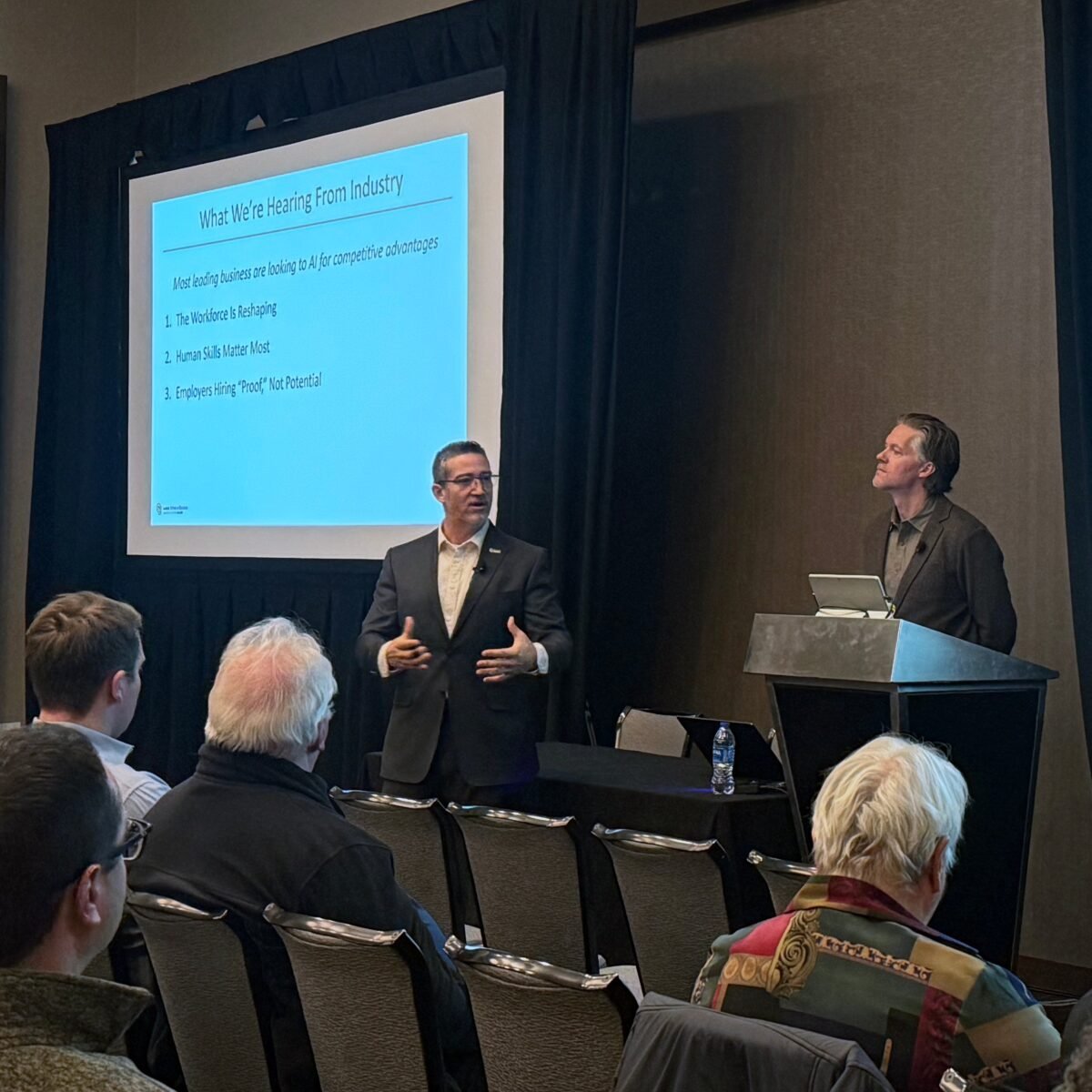
At the Colorado Business Economic Outlook Forum on Dec. 8, Jeremiah Contreras and Matthew Brady presented “Talent in Transition: Building an AI-Ready Workforce.”
Understanding the AI Shift
Artificial intelligence has moved from the margins to the mainstream of business. It’s no longer a future concept—it’s a present reality reshaping roles, redefining skills, and challenging how organizations build their workforce.
Kala and Shiv Khatri Endowed Faculty Scholar and Associate Teaching Professor Jeremiah Contreras, along with Assistant Teaching Professor Matthew Brady, walked attendees through AI’s evolution—from early machine learning to agentic AI and the theoretical future of artificial superintelligence, where AI could surpass human intelligence across various domains.
So how is Leeds preparing students for this rapidly changing landscape? In a realm filled with uncertainty, evolving regulations, and unpredictable effects, they outlined both challenges and opportunities.
“The reality right now is that our graduates are facing higher unemployment,” said Contreras, noting that entry-level jobs are experiencing the most significant impact. “Entry-level roles are being compressed as routine tasks become automated, and the skill set required to enter the workforce is rising.” He illustrated this by sharing some of the year’s layoff headlines from companies like Workday, Salesforce, Microsoft, and Amazon.
Preparing Students for a New Workforce
While organizations will still have a C-suite and layers of management, entry-level positions are likely to vanish. “We need to prepare students with the judgment and oversight skills now expected at the start of their careers, skills traditionally seen in manager-level positions,” said Contreras. “Employers are really looking to hire proof, not potential.”
Employers are seeking algorithmic thinking and evidence that students possess problem-solving skills. While coding isn’t essential, critical thinking that incorporates logic and reasoning is crucial. “Employers expect competence, judgment, and adaptability,” he noted.
This shift is altering higher education. Many students already use AI with minimal guidance or oversight, a trend that Contreras sees as the biggest risk. “For learning to be impactful, AI cannot simply act as an answer machine.”
“Employers are really looking to hire proof, not potential.”
Jeremiah Contreras, Associate Teaching Professor
When used effectively, AI can enhance learning and promote critical thinking, Brady believes. He employs AI as a teaching assistant in one of his courses, available 24/7 for students. His bespoke tool incorporates what the industry refers to as “guardrails,” directing students to course materials and lecture slides instead of doing the work for them.
“The same way that a human teaching assistant is artful and graceful in allowing for productive struggle, AI can be trained to facilitate learning in the same way,” he mentioned. An additional advantage is that the tool can support shy students who may not advocate for themselves in class.
Redefining Business Education in an AI Era
The Leeds AI Initiative, launched in March 2024 by Tandean Rustandy Endowed Dean Vijay Khatri, positions Leeds as a leader in responsible AI education. It addresses the use of AI in operations, research, teaching, and learning.
Leeds has integrated AI across all 14 core business courses and is exploring further integration in all undergraduate and graduate courses. “Every class should at least consider the implications of AI,” Contreras said. New courses are also being developed, including Brady’s AI & Automation for Tomorrow’s Societies, an inaugural cohort program with Nagoya University in Japan, launching this spring.
Contreras cautioned that the biggest risk to students is allowing AI to think for them. Leeds is setting an example in how to use AI intentionally, strategically, and responsibly through a three-pronged approach:
- Strengthening learning and critical thinking
- Teaching AI as a workplace skill
- Knowing when and where to implement tech-free zones
Educators must rethink how they assign and assess work, starting with K-12 education. “We must get this right,” said Contreras.
Business leaders will shape not just how AI is adopted but how it impacts people and organizations. Their choices will influence whether AI becomes a tool for progress or a source of disruption. For educators, the priority remains clear: continue teaching human skills—emphasizing what AI cannot replicate. Contreras urges all of us, as we navigate this new era, to stay informed and engaged, monitor emerging AI policies, mentor students, and keep doing what we do best: being human.
Curious about AI at Leeds? Learn about the Leeds AI Advisory Committee and the AI Club >>


