
Cyber threats are becoming more advanced every year. From ransomware attacks and phishing scams to sophisticated malware and data breaches, organizations face constant security risks. Traditional cybersecurity methods often struggle to keep up with the speed and complexity of modern attacks.
Artificial Intelligence (AI) is rapidly transforming cybersecurity by enabling faster threat detection, smarter defense mechanisms, and automated incident responses. AI-powered systems can analyze massive amounts of data, detect suspicious behavior, and respond to threats in real time.
In this article, we explore how AI is revolutionizing cybersecurity, its benefits, challenges, and what the future holds.
Why Cybersecurity Needs Artificial Intelligence
Modern cyberattacks are no longer simple or isolated incidents. Hackers now use automated tools, botnets, and advanced malware that can bypass traditional security systems.
Security teams must analyze enormous amounts of data, including:
- Network activity
- User behavior
- Application logs
- System alerts
AI helps by processing this data much faster than humans and identifying patterns that indicate potential threats.
Without AI, many attacks could go unnoticed until serious damage has already occurred.
What Is AI in Cybersecurity?
AI in cybersecurity refers to the use of machine learning algorithms, data analysis, and automated systems to detect, prevent, and respond to cyber threats.
Instead of relying only on predefined rules, AI-powered security tools learn from data and continuously improve their ability to detect attacks.
Companies like CrowdStrike and Darktrace have developed AI-driven security platforms that monitor systems and identify threats in real time.
These platforms use advanced analytics to detect suspicious behavior across networks and devices.
How AI Detects Cyber Threats
AI systems analyze massive datasets to identify anomalies and potential security risks.
Behavioral Analysis
AI learns how users and systems normally behave. When unusual activity occurs, such as unauthorized access attempts, the system can flag it as suspicious.
Pattern Recognition
Machine learning models can recognize patterns associated with malware, phishing attacks, and other threats.
This allows security tools to detect even previously unknown attack methods.
Real-Time Monitoring
AI-powered systems continuously monitor networks and devices 24/7, identifying threats immediately.
This reduces the time between attack detection and response.
Predictive Threat Intelligence
AI can analyze historical attack data to predict future threats and vulnerabilities.
Organizations can take preventive measures before attacks happen.
Key Applications of AI in Cybersecurity
Threat Detection
AI can analyze billions of security events and quickly identify malicious activity that traditional systems might miss.
Phishing Detection
AI tools can detect phishing emails by analyzing language patterns, sender behavior, and suspicious links.
Malware Detection
Machine learning models can identify new malware variants by recognizing abnormal behavior instead of relying only on known signatures.
Fraud Detection
Financial institutions use AI to monitor transactions and detect unusual spending patterns.
Automated Incident Response
AI-powered systems can automatically isolate infected devices, block malicious IP addresses, and stop attacks before they spread.
Benefits of AI in Cybersecurity
Faster Threat Detection
AI identifies threats within seconds, significantly reducing response time.
Improved Accuracy
Machine learning reduces false positives and improves detection accuracy.
Scalability
AI systems can monitor thousands of devices and networks simultaneously.
Continuous Protection
Unlike human analysts, AI systems operate 24 hours a day without fatigue.
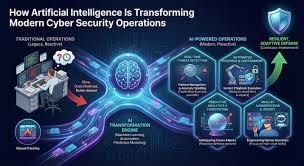
AI vs Traditional Cybersecurity Approaches
| Traditional Security | AI-Powered Security |
|---|---|
| Signature-based detection | Behavior-based detection |
| Reactive defense | Predictive defense |
| Manual analysis | Automated analysis |
| Limited scalability | High scalability |
AI allows cybersecurity systems to become proactive instead of reactive.
Challenges and Risks of AI in Cybersecurity
While AI offers many benefits, it also introduces new challenges.
AI-Powered Cyberattacks
Cybercriminals are also using AI to develop advanced malware and automated hacking tools.
Data Privacy Issues
AI systems require large datasets, which may raise concerns about user privacy and data protection.
Adversarial Attacks
Hackers may manipulate AI models by feeding them misleading data, causing them to misidentify threats.
Overreliance on Automation
Organizations should combine AI tools with human expertise rather than relying solely on automated systems.
Real-World Uses of AI in Cybersecurity
AI security systems are already widely used in industries such as:
- Banking and finance
- Healthcare
- Government agencies
- Cloud computing services
For example, banks use AI to detect fraudulent transactions instantly, preventing financial losses.
Large enterprises also use AI-driven endpoint security tools to protect employee devices from malware and ransomware.
The Future of AI in Cybersecurity
The role of AI in cybersecurity will continue to grow.
Future developments may include:
Autonomous Security Systems
Self-learning systems that automatically identify and respond to threats.
AI-Powered Threat Intelligence Networks
Organizations sharing AI-driven threat data globally to improve defenses.
Self-Healing Networks
Networks that automatically repair vulnerabilities after detecting an attack.
AI-Based Identity Protection
Advanced identity verification systems that detect unauthorized access attempts.
Best Practices for Implementing AI Security
Organizations should follow these steps when adopting AI-powered security systems:
- Combine AI tools with human security experts
- Regularly update machine learning models
- Protect AI training data from manipulation
- Integrate AI tools with existing security infrastructure
A balanced strategy ensures the best protection.
Final Thoughts
Artificial intelligence is becoming a critical component of modern cybersecurity. By enabling faster threat detection, predictive analytics, and automated responses, AI helps organizations defend against increasingly sophisticated cyber threats.
However, AI is not a complete replacement for human expertise. The most effective cybersecurity strategies combine AI-powered tools with skilled security professionals.
As cyber threats continue evolving, AI will play an essential role in shaping the future of digital security.
SEO FAQs
Q: How is AI used in cybersecurity?
AI is used to detect cyber threats, analyze patterns, prevent attacks, and automate incident responses.
Q: Can AI prevent cyberattacks completely?
AI improves detection and prevention but should be combined with human security expertise.
Q: Are hackers using AI too?
Yes, cybercriminals are using AI to develop more sophisticated attacks.
Q: Why is AI important for cybersecurity?
AI helps analyze massive datasets and detect threats faster than traditional security systems.