

Cybersecurity is evolving rapidly as cyber threats become more sophisticated and widespread. Traditional security systems are no longer enough to combat modern attacks. This is where Artificial Intelligence (AI) comes in—revolutionizing how organizations detect, prevent, and respond to cyber threats.
AI is enabling faster threat detection, smarter defense systems, and automated responses that reduce human intervention and improve efficiency.
In this article, we explore how AI is transforming cybersecurity, its benefits, challenges, and what the future holds.
What Is AI in Cybersecurity?
AI in cybersecurity refers to the use of artificial intelligence technologies such as machine learning and data analytics to detect and respond to threats.
Organizations like IBM and CrowdStrike are leveraging AI to build advanced security solutions.
Why AI Is Important in Cybersecurity
Faster Threat Detection
AI can analyze large volumes of data in real time.
Improved Accuracy
Machine learning reduces false positives.
Automated Responses
AI systems can respond to threats instantly.
Predictive Capabilities
AI can identify potential threats before they occur.
How AI Is Used in Cybersecurity
Threat Detection
AI identifies unusual patterns and behaviors that indicate potential attacks.
Malware Detection
AI can detect new and unknown malware variants.
Phishing Prevention
AI analyzes emails and messages to identify phishing attempts.
Network Security
AI monitors network traffic for suspicious activity.
Fraud Detection
Used in financial systems to detect fraudulent transactions.
Key Technologies Behind AI Cybersecurity
Machine Learning
Allows systems to learn from data and improve over time.
Deep Learning
Advanced neural networks for complex pattern recognition.
Natural Language Processing (NLP)
Analyzes text for phishing and social engineering detection.
Behavioral Analytics
Tracks user behavior to detect anomalies.
Benefits of AI in Cybersecurity
Real-Time Protection
Immediate detection and response to threats.
Scalability
Handles large amounts of data efficiently.
Reduced Human Workload
Automates repetitive security tasks.
Enhanced Threat Intelligence
Provides insights into attack patterns.
Challenges of AI in Cybersecurity
High Implementation Costs
Advanced AI systems can be expensive.
Data Privacy Concerns
Handling sensitive data requires caution.
Skill Gap
Requires skilled professionals to manage AI systems.
Adversarial AI
Attackers can also use AI to launch sophisticated attacks.
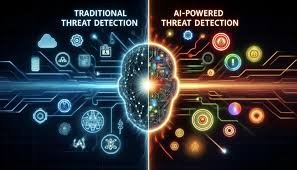
AI vs Traditional Cybersecurity
| Aspect | Traditional Security | AI-Powered Security |
|---|---|---|
| Detection | Rule-based | Behavior-based |
| Speed | Slower | Real-time |
| Adaptability | Limited | High |
| Accuracy | Moderate | High |
Future Trends in AI & Cybersecurity
Autonomous Security Systems
AI systems operating with minimal human intervention.
AI-Powered SOCs (Security Operations Centers)
Automated monitoring and response systems.
Zero Trust Integration
AI supporting continuous verification of users.
AI-Driven Threat Hunting
Proactively searching for hidden threats.
How Businesses Can Implement AI Security
Assess Security Needs
Identify vulnerabilities and risks.
Choose AI Tools
Select appropriate AI-powered security solutions.
Integrate with Existing Systems
Combine AI with current security infrastructure.
Train Teams
Ensure staff understand AI tools and processes.
Best Practices
Combine AI with Human Expertise
AI should support, not replace, human decision-making.
Regularly Update Systems
Keep AI models updated with new data.
Monitor Performance
Evaluate effectiveness continuously.
Ensure Data Security
Protect sensitive data used by AI systems.
Final Thoughts
AI is transforming cybersecurity by providing faster, smarter, and more efficient ways to detect and prevent threats. As cyberattacks become more complex, AI will play an increasingly important role in defending digital systems.
While challenges exist, the benefits of AI-driven security far outweigh the risks. Organizations that adopt AI in their cybersecurity strategies will be better equipped to protect their data, systems, and users.
The future of cybersecurity lies in the combination of human expertise and intelligent machines working together to create a safer digital world.
SEO FAQs
Q: What is AI in cybersecurity?
It is the use of artificial intelligence to detect and prevent cyber threats.
Q: How does AI improve security?
By analyzing data, detecting threats, and automating responses.
Q: Can AI replace cybersecurity professionals?
No, it enhances their capabilities.
Q: What are the risks of AI in cybersecurity?
High costs, data privacy concerns, and adversarial AI threats.