

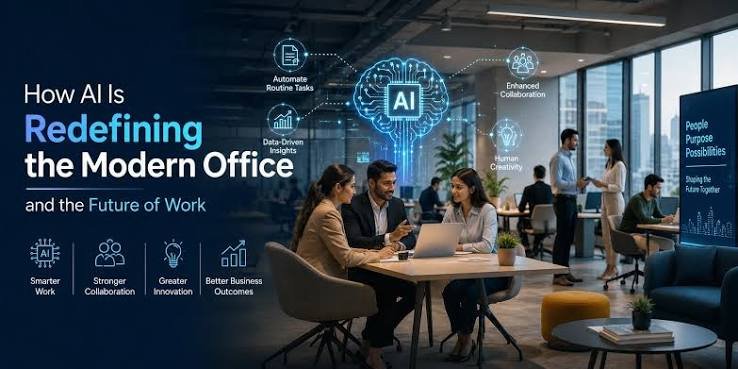
Artificial Intelligence (AI) has evolved from a futuristic concept into one of the most influential technologies shaping today’s business landscape. Organizations of all sizes—from startups and small businesses to multinational enterprises—are using AI to improve efficiency, automate repetitive tasks, enhance customer experiences, analyze data faster, and make better decisions.
AI is no longer limited to technology companies. Healthcare providers, financial institutions, retailers, manufacturers, educational organizations, logistics companies, and government agencies are increasingly integrating AI into their daily operations. Whether it’s a chatbot answering customer questions, an AI assistant helping employees draft reports, or predictive analytics forecasting sales trends, AI is becoming an essential part of modern business.
This comprehensive guide explores how AI is transforming business operations, the technologies behind it, practical use cases across industries, implementation strategies, challenges, best practices, and what the future holds.
What Is AI in Business?
AI in business refers to the use of artificial intelligence technologies to automate processes, analyze information, support decision-making, improve customer interactions, and increase productivity.
Instead of relying solely on manual work or fixed software rules, AI systems can recognize patterns, process natural language, generate content, make predictions, and assist with complex tasks.
Business AI commonly includes:
- Machine Learning (ML)
- Natural Language Processing (NLP)
- Computer Vision
- Predictive Analytics
- Speech Recognition
- Generative AI
- Intelligent Automation
These technologies help organizations work smarter rather than simply faster.
Why Businesses Are Investing in AI
Companies are adopting AI because it offers significant competitive advantages.
Key benefits include:
- Increased productivity
- Reduced operational costs
- Better customer service
- Faster decision-making
- Improved accuracy
- Enhanced personalization
- Scalable operations
- Greater innovation
Businesses that implement AI responsibly often gain efficiencies while allowing employees to focus on higher-value work.
Core AI Technologies Used in Business
Machine Learning
Machine learning enables systems to identify patterns in data and improve predictions over time.
Business applications include:
- Sales forecasting
- Fraud detection
- Demand prediction
- Customer segmentation
- Recommendation engines
Natural Language Processing (NLP)
NLP allows computers to understand and generate human language.
Common business uses include:
- AI chatbots
- Email classification
- Language translation
- Sentiment analysis
- Document summarization
Generative AI
Generative AI creates new content such as text, images, code, audio, or video based on user prompts.
Businesses use it for:
- Marketing content
- Product descriptions
- Customer support responses
- Software development assistance
- Internal documentation
- Creative brainstorming
Human review remains important for accuracy, compliance, and quality.
Computer Vision
Computer vision enables AI systems to analyze images and videos.
Applications include:
- Quality inspection
- Facial recognition (where legally appropriate)
- Inventory management
- Medical imaging
- Manufacturing automation
Predictive Analytics
Predictive analytics uses historical data to estimate future outcomes.
Businesses use predictive models for:
- Inventory planning
- Customer retention
- Equipment maintenance
- Revenue forecasting
- Risk management
AI in Customer Service
Customer service is one of the most common applications of AI.
AI-powered solutions can:
- Answer frequently asked questions
- Route support tickets
- Provide 24/7 assistance
- Suggest relevant knowledge base articles
- Analyze customer satisfaction
- Translate conversations
Benefits include:
- Faster response times
- Lower support costs
- Improved customer experiences
- Better scalability
Complex or sensitive cases should still be handled by trained human agents.
AI in Marketing
Marketing teams increasingly use AI to improve campaign performance.
Applications include:
- Content generation
- Email personalization
- Audience segmentation
- Campaign optimization
- Keyword research
- Social media scheduling
- Ad performance analysis
AI helps marketers make data-informed decisions while reducing repetitive work.
AI in Sales
Sales departments benefit from AI through:
- Lead scoring
- Customer insights
- Sales forecasting
- Proposal generation
- CRM automation
- Meeting summaries
- Opportunity recommendations
AI supports sales professionals by organizing information and highlighting opportunities.
AI in Human Resources
HR teams use AI to streamline administrative processes.
Examples include:
- Resume screening
- Candidate matching
- Interview scheduling
- Employee onboarding
- Skills analysis
- Learning recommendations
Organizations should regularly review hiring systems to help reduce unintended bias and ensure fair decision-making.
AI in Finance
Financial departments use AI for:
- Fraud detection
- Expense analysis
- Invoice automation
- Budget forecasting
- Financial reporting
- Credit risk assessment
AI can improve efficiency while supporting more informed financial decisions.
AI in Cybersecurity
Cybersecurity teams leverage AI to:
- Detect unusual activity
- Monitor networks
- Identify malware
- Prioritize alerts
- Analyze security logs
- Support incident response
AI enhances security operations but does not replace the need for skilled security professionals.
AI in Supply Chain Management
Supply chains become more efficient through:
- Demand forecasting
- Route optimization
- Inventory prediction
- Warehouse automation
- Delivery scheduling
- Supplier risk analysis
AI helps organizations improve operational resilience and reduce waste.
AI in Manufacturing
Manufacturers use AI to support:
- Predictive maintenance
- Quality control
- Robotics
- Production planning
- Equipment monitoring
- Safety analysis
These applications can improve efficiency while reducing downtime.
AI for Business Analytics
Business leaders increasingly rely on AI to interpret large datasets.
AI analytics supports:
- Trend identification
- Interactive dashboards
- Predictive reporting
- KPI monitoring
- Customer insights
- Operational analysis
Better insights often lead to faster and more confident decision-making.
Benefits of AI in Business
Organizations implementing AI effectively often experience:
Higher Productivity
Automation reduces repetitive manual tasks.
Better Decision-Making
AI analyzes data quickly, helping leaders identify patterns and opportunities.
Improved Customer Experiences
Personalized recommendations and faster support improve customer satisfaction.
Cost Savings
Automation and optimization can reduce operational expenses.
Increased Innovation
AI enables new products, services, and business models.
Scalability
AI systems can handle growing workloads without requiring proportional increases in staffing.
Challenges of AI Adoption
Despite its advantages, AI implementation presents several challenges.
Data Quality
AI depends on accurate, relevant, and well-managed data.
Poor-quality data may reduce performance.
Privacy
Organizations must handle personal information responsibly and comply with applicable privacy regulations.
Security
AI systems should be protected against unauthorized access, manipulation, and data breaches.
Employee Adoption
Employees may require training to use AI tools effectively.
Change management plays an important role in successful adoption.
Bias and Fairness
AI models can reflect biases present in training data.
Regular testing and human oversight help improve fairness and accountability.
How to Implement AI Successfully
Step 1: Define Business Objectives
Identify problems AI should solve.
Examples:
- Improve customer support
- Increase sales
- Reduce operating costs
- Automate repetitive tasks
Step 2: Assess Existing Processes
Review current workflows and identify opportunities for automation or improvement.
Step 3: Prepare Your Data
Clean, organize, and secure business data before introducing AI systems.
Step 4: Select Appropriate AI Tools
Evaluate solutions based on:
- Business needs
- Integration capabilities
- Security
- Scalability
- Vendor support
- Ease of use
Step 5: Train Employees
Provide practical training on:
- AI capabilities
- Responsible use
- Data privacy
- Workflow integration
Employees should understand both the strengths and limitations of AI.
Step 6: Monitor Performance
Measure outcomes using KPIs such as:
- Productivity improvements
- Customer satisfaction
- Cost reductions
- Revenue growth
- Automation rates
- Employee adoption
Continuous monitoring helps refine AI strategies.
Ethical AI in Business
Responsible AI adoption includes:
- Transparency
- Human oversight
- Privacy protection
- Fairness
- Accountability
- Security
- Compliance with applicable laws and regulations
Organizations should establish governance policies to guide AI use.
Industries Benefiting from AI
Healthcare
- Clinical decision support
- Administrative automation
- Medical imaging assistance
- Patient engagement
Retail
- Personalized shopping
- Inventory optimization
- Demand forecasting
- Customer analytics
Banking
- Fraud prevention
- Risk analysis
- Customer service automation
- Financial forecasting
Education
- Personalized learning
- Administrative support
- Student analytics
- Intelligent tutoring
Logistics
- Route planning
- Fleet optimization
- Warehouse management
- Predictive maintenance
Future Trends in AI for Business
Several trends are expected to shape the next generation of business AI.
AI Agents
AI agents capable of completing multi-step tasks, coordinating workflows, and interacting with business systems are becoming increasingly common.
Hyperautomation
Businesses are combining AI with robotic process automation (RPA) to automate increasingly complex workflows.
Multimodal AI
Future AI systems will work seamlessly across text, images, audio, video, and structured data.
AI Copilots
AI assistants integrated into productivity software will increasingly support writing, coding, analysis, scheduling, and collaboration.
Responsible AI Governance
Organizations are investing more in governance frameworks to ensure AI systems remain transparent, secure, and accountable.
Best Practices for Businesses
To maximize AI’s value:
- Start with clearly defined business problems.
- Focus on measurable outcomes.
- Keep humans involved in important decisions.
- Protect sensitive data.
- Train employees continuously.
- Review AI outputs for accuracy.
- Monitor performance over time.
- Stay informed about evolving regulations and industry standards.
AI in Business Checklist
Before launching an AI initiative, make sure you:
- ✅ Define clear business goals.
- ✅ Identify high-impact use cases.
- ✅ Assess data quality.
- ✅ Choose secure and scalable AI tools.
- ✅ Train employees.
- ✅ Establish governance and oversight.
- ✅ Monitor AI performance.
- ✅ Protect customer privacy.
- ✅ Measure return on investment (ROI).
- ✅ Continuously improve based on feedback.
Conclusion
Artificial intelligence is transforming the way businesses operate by improving efficiency, supporting smarter decisions, enhancing customer experiences, and enabling innovation across industries. From customer service and marketing to finance, cybersecurity, and supply chain management, AI is helping organizations automate routine work while uncovering valuable insights from data.
However, successful AI adoption requires more than choosing the latest tools. Businesses need high-quality data, strong governance, employee training, thoughtful implementation strategies, and ongoing human oversight. Organizations that approach AI responsibly—balancing automation with accountability and innovation with security—are best positioned to realize its long-term benefits.
As AI technologies continue to evolve, they will become even more integrated into everyday business operations. Companies that invest in learning, experimentation, and responsible deployment today will be better prepared to compete, adapt, and grow in the years ahead.
Frequently Asked Questions (FAQs)
1. What is AI in business?
AI in business refers to the use of artificial intelligence technologies to automate processes, analyze data, improve customer experiences, support decision-making, and increase operational efficiency.
2. Which industries benefit most from AI?
AI is widely used across healthcare, finance, retail, manufacturing, education, logistics, customer service, marketing, and many other industries.
3. Can small businesses use AI?
Yes. Many AI-powered tools are affordable and designed for small businesses, helping automate tasks such as customer support, content creation, scheduling, analytics, and marketing.
4. Will AI replace employees?
AI is more likely to automate specific tasks rather than replace entire roles. Many organizations use AI to assist employees, allowing them to focus on strategic, creative, and interpersonal work.
5. How can businesses start using AI?
Businesses should begin by identifying clear goals, evaluating current workflows, preparing quality data, selecting suitable AI tools, training employees, and monitoring results to ensure continuous improvement.


