

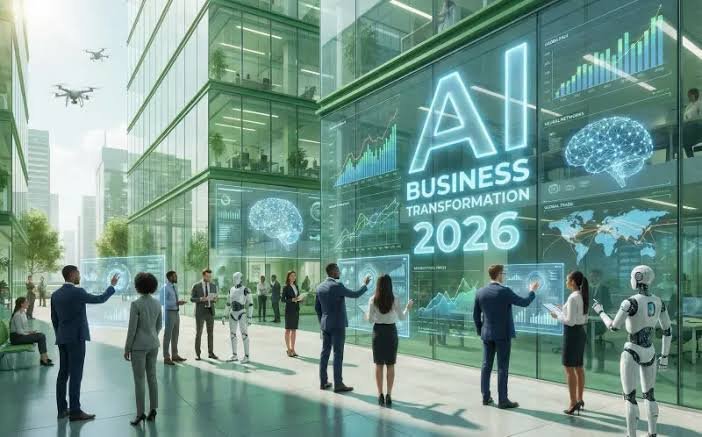
Artificial Intelligence (AI) has evolved from a futuristic concept into one of the most impactful technologies driving business innovation today. Organizations of every size—from startups and small businesses to multinational corporations—are adopting AI to automate repetitive tasks, analyze massive amounts of data, improve customer experiences, optimize operations, and support faster decision-making.
In 2026, AI is no longer limited to technology companies. Retailers use AI to personalize shopping experiences, manufacturers optimize production with predictive maintenance, financial institutions detect fraud in real time, healthcare providers improve diagnostics, and marketing teams create targeted campaigns using intelligent analytics.
Businesses that strategically integrate AI can increase efficiency, reduce operational costs, uncover new opportunities, and remain competitive in rapidly changing markets. However, successful AI adoption also requires careful planning, responsible governance, employee training, and attention to privacy, security, and ethics.
This comprehensive guide explores how AI is transforming modern businesses, its benefits, challenges, practical applications, implementation strategies, and future trends.
What Is AI in Business?
AI in business refers to the use of artificial intelligence technologies to improve business operations, automate processes, support decision-making, and create value for customers and organizations.
AI systems can perform tasks such as:
- Analyzing large datasets
- Recognizing patterns
- Making predictions
- Understanding natural language
- Generating content
- Automating workflows
- Detecting anomalies
- Assisting customer interactions
Rather than replacing every human role, AI is most effective when it complements human expertise by handling repetitive, data-intensive, or time-consuming activities.
Why Businesses Are Adopting AI
Several factors are accelerating AI adoption across industries.
Increased Productivity
AI automates routine tasks, allowing employees to focus on strategic, creative, and customer-facing work.
Examples include:
- Data entry
- Report generation
- Document processing
- Scheduling
- Email categorization
Automation reduces manual effort while improving consistency.
Better Decision-Making
AI analyzes historical and real-time data to provide insights that support informed business decisions.
Organizations use AI for:
- Sales forecasting
- Demand prediction
- Customer segmentation
- Risk analysis
- Inventory planning
Data-driven insights help leaders respond more quickly to market changes.
Improved Customer Experience
Modern consumers expect personalized and responsive service.
AI enables businesses to:
- Recommend products
- Deliver personalized content
- Provide 24/7 customer support
- Analyze customer feedback
- Predict customer needs
These capabilities strengthen customer satisfaction and loyalty.
Key AI Technologies Used in Business
Machine Learning
Machine learning enables systems to identify patterns and improve performance over time without being explicitly programmed for every scenario.
Business applications include:
- Fraud detection
- Sales forecasting
- Product recommendations
- Predictive maintenance
Natural Language Processing (NLP)
NLP allows computers to understand and generate human language.
Common uses include:
- Chatbots
- Virtual assistants
- Document summarization
- Language translation
- Sentiment analysis
Computer Vision
Computer vision enables software to interpret images and videos.
Business applications include:
- Quality inspection
- Facial recognition (where legally and ethically appropriate)
- Inventory management
- Medical imaging
- Retail analytics
Generative AI
Generative AI creates new content such as:
- Articles
- Images
- Code
- Marketing copy
- Presentations
- Product descriptions
Businesses use generative AI to accelerate creative workflows while maintaining human review for accuracy and quality.
AI Applications Across Business Functions
Marketing
AI supports marketing by:
- Generating campaign ideas
- Personalizing content
- Predicting customer behavior
- Optimizing advertising
- Analyzing campaign performance
Marketing teams can create more relevant experiences while improving efficiency.
Sales
Sales organizations use AI to:
- Score leads
- Forecast revenue
- Identify buying signals
- Recommend next actions
- Automate follow-ups
AI helps sales professionals prioritize opportunities and improve customer engagement.
Customer Service
AI-powered customer service includes:
- Chatbots
- Virtual assistants
- Automated ticket routing
- Knowledge base search
- Call summarization
These tools provide faster responses while allowing human agents to focus on more complex issues.
Human Resources
HR departments increasingly use AI for:
- Resume screening
- Interview scheduling
- Employee onboarding
- Learning recommendations
- Workforce analytics
Organizations should ensure AI-assisted hiring processes are regularly reviewed for fairness and compliance.
Finance
Finance teams leverage AI for:
- Fraud detection
- Expense analysis
- Budget forecasting
- Financial reporting
- Risk assessment
AI improves visibility while supporting more informed financial planning.
Operations
Operations teams use AI to:
- Optimize supply chains
- Predict equipment maintenance
- Improve logistics
- Manage inventory
- Automate workflows
Operational efficiency often improves through better forecasting and automation.
Cybersecurity
AI strengthens cybersecurity by:
- Detecting unusual behavior
- Identifying malware
- Monitoring networks
- Prioritizing threats
- Supporting incident response
AI assists security teams but should be combined with human oversight.
Benefits of AI in Business
Organizations implementing AI effectively may experience:
Higher Productivity
Automation reduces repetitive work and allows employees to concentrate on higher-value activities.
Better Customer Engagement
Personalized experiences improve customer satisfaction and retention.
Faster Decision-Making
Real-time analytics provide timely insights for strategic planning.
Cost Optimization
Automation can reduce operational expenses while improving efficiency.
Improved Accuracy
AI helps minimize certain types of human error in repetitive processes.
Business Scalability
AI-powered systems enable businesses to handle increasing workloads without proportional increases in manual effort.
Challenges of AI Adoption
Despite its benefits, AI implementation also presents challenges.
Data Quality
AI systems depend on accurate, relevant, and well-managed data.
Poor-quality data can reduce reliability and performance.
Employee Adoption
Employees may need training to understand AI tools and integrate them into daily workflows.
Change management is an essential part of successful implementation.
Privacy and Security
Businesses should protect sensitive information and comply with applicable data privacy regulations when deploying AI solutions.
Ethical Considerations
Organizations should evaluate AI systems for:
- Fairness
- Transparency
- Accountability
- Explainability
- Human oversight
Responsible AI practices strengthen trust.
Integration Complexity
Connecting AI with existing software and business processes may require planning, testing, and ongoing maintenance.
How to Implement AI Successfully
Step 1: Identify Business Goals
Define the problems AI should help solve.
Examples include:
- Reducing support response times
- Improving demand forecasting
- Automating document processing
- Enhancing customer personalization
Clear objectives guide implementation.
Step 2: Assess Data Readiness
Review:
- Data quality
- Data availability
- Security controls
- Privacy requirements
Reliable data improves AI performance.
Step 3: Start with Small Projects
Pilot projects help organizations evaluate AI solutions before scaling.
Early successes build confidence and provide valuable lessons.
Step 4: Train Employees
Provide training on:
- AI capabilities
- Responsible use
- Data handling
- Human oversight
- Workflow integration
Employees should understand both the opportunities and limitations of AI.
Step 5: Measure Results
Track metrics such as:
- Productivity improvements
- Customer satisfaction
- Cost savings
- Revenue growth
- Error reduction
- Time savings
Regular evaluation supports continuous improvement.
AI Governance
Organizations should establish governance frameworks covering:
- Acceptable AI use
- Data management
- Risk assessment
- Human review
- Security controls
- Compliance monitoring
Strong governance helps ensure AI is used responsibly.
AI for Small Businesses
Small businesses can also benefit from AI.
Affordable AI solutions support:
- Customer support
- Email marketing
- Appointment scheduling
- Social media management
- Accounting assistance
- Content creation
Cloud-based AI tools make advanced capabilities more accessible than ever.
Industry Examples
Retail
Retailers use AI for:
- Product recommendations
- Inventory optimization
- Demand forecasting
- Customer personalization
Healthcare
Healthcare organizations apply AI to:
- Clinical decision support
- Medical imaging analysis
- Administrative automation
- Patient engagement
AI should complement, not replace, professional medical judgment.
Manufacturing
Manufacturers leverage AI for:
- Predictive maintenance
- Quality control
- Supply chain optimization
- Production planning
Financial Services
Financial institutions use AI for:
- Fraud detection
- Credit risk analysis
- Customer support
- Regulatory monitoring
Education
Educational organizations use AI to:
- Personalize learning
- Automate administrative tasks
- Support tutoring
- Analyze student performance
Future Trends in AI for Business
Several developments are expected to shape the future.
AI Agents
Autonomous AI agents will increasingly assist with planning, research, workflow coordination, and task execution under human supervision.
Hyperautomation
Businesses will combine AI with robotic process automation (RPA) to automate increasingly complex workflows.
Predictive Analytics
AI will provide more accurate forecasting for finance, marketing, operations, and supply chain management.
Responsible AI
Greater emphasis will be placed on transparency, explainability, fairness, and governance.
Human-AI Collaboration
The future of work will focus on combining AI capabilities with human creativity, judgment, and relationship-building.
Best Practices for Businesses
Organizations adopting AI should:
- Define clear business objectives.
- Start with measurable use cases.
- Invest in data quality.
- Maintain human oversight.
- Train employees regularly.
- Monitor AI performance.
- Protect sensitive information.
- Review ethical considerations.
- Update governance policies.
- Continuously improve AI systems.
AI in Business Checklist
Before implementing AI, ensure that you:
- ✅ Identify a specific business problem.
- ✅ Assess data quality and availability.
- ✅ Choose appropriate AI tools.
- ✅ Train employees.
- ✅ Protect customer data.
- ✅ Establish governance policies.
- ✅ Measure key performance indicators.
- ✅ Review AI outputs regularly.
- ✅ Maintain compliance with relevant regulations.
- ✅ Continuously optimize AI solutions.
Conclusion
Artificial intelligence has become a transformative force across nearly every industry, enabling organizations to improve efficiency, strengthen customer relationships, enhance decision-making, and accelerate innovation. From marketing and finance to customer service, cybersecurity, and operations, AI is helping businesses automate routine work while uncovering valuable insights from data.
Successful AI adoption requires more than selecting the right technology. It depends on clear objectives, high-quality data, responsible governance, employee training, and a commitment to ethical practices. Businesses that thoughtfully integrate AI into their operations can create more agile, resilient, and customer-focused organizations while empowering employees to concentrate on creative, strategic, and high-impact work.
As AI capabilities continue to evolve, organizations that embrace continuous learning, responsible innovation, and human-AI collaboration will be best positioned to thrive in the increasingly digital economy.
Frequently Asked Questions (FAQs)
1. What is AI in business?
AI in business refers to the use of artificial intelligence technologies to automate tasks, analyze data, improve decision-making, enhance customer experiences, and optimize business operations.
2. How does AI help small businesses?
AI helps small businesses automate customer support, create marketing content, analyze sales trends, manage schedules, improve productivity, and streamline administrative tasks without requiring large technology teams.
3. Can AI replace employees?
AI is more likely to automate specific tasks than entire jobs. In many organizations, AI supports employees by handling repetitive work, allowing people to focus on creativity, problem-solving, relationship management, and strategic decision-making.
4. What industries benefit most from AI?
Retail, healthcare, finance, manufacturing, logistics, education, marketing, customer service, and cybersecurity are among the industries seeing significant benefits from AI adoption.
5. What should businesses consider before implementing AI?
Organizations should define clear goals, evaluate data quality, protect privacy, train employees, establish governance policies, monitor AI performance, and ensure ongoing human oversight.


