Introduction
As cyber threats grow more sophisticated, traditional security systems are struggling to keep up. Attackers now use automation, AI-driven malware, and advanced social engineering techniques to exploit vulnerabilities at scale. To counter these evolving threats, organizations are turning to Artificial Intelligence (AI).
AI in cybersecurity is revolutionizing how businesses detect, prevent, and respond to cyberattacks—making security systems faster, smarter, and more proactive.
In this article, we explore how AI enhances cybersecurity, real-world applications, benefits, risks, and what the future holds.
Why Cybersecurity Needs AI
Modern networks generate massive volumes of data every second. Human analysts alone cannot monitor, analyze, and respond to threats in real time.
AI helps by:
- Detecting unusual patterns instantly
- Automating threat response
- Reducing false positives
- Predicting potential vulnerabilities
- Adapting to new attack techniques
AI transforms cybersecurity from reactive to predictive.
Key Applications of AI in Cybersecurity
🔍 Threat Detection & Monitoring
AI algorithms analyze network traffic, system logs, and user behavior to identify suspicious activity.
Security platforms from companies like CrowdStrike use AI-driven analytics to detect threats before they escalate.
🦠 Malware & Ransomware Prevention
AI can recognize malicious code patterns—even new variants that traditional antivirus software might miss.
Solutions from Palo Alto Networks leverage machine learning to identify emerging malware threats.
📊 Behavioral Analytics
AI monitors user behavior to detect anomalies such as:
- Unusual login locations
- Suspicious file access
- Abnormal data transfers
If behavior deviates from normal patterns, the system flags it automatically.
🤖 Automated Incident Response
AI-powered systems can:
- Isolate infected devices
- Block suspicious IP addresses
- Trigger alerts instantly
- Contain threats without human intervention
This reduces response time from hours to seconds.
🎣 Phishing Detection
AI analyzes email content, sender behavior, and communication patterns to identify phishing attempts.
Platforms integrated with services like Microsoft use AI to filter malicious emails before they reach users.
Benefits of AI in Cybersecurity
✅ Faster Threat Detection
AI processes vast datasets in milliseconds.
✅ Reduced Human Error
Automation minimizes mistakes in monitoring and response.
✅ Scalability
AI systems can protect large networks without proportional increases in staff.
✅ Adaptive Learning
Machine learning models evolve as new threats emerge.
Challenges & Risks
While AI strengthens cybersecurity, it also presents challenges:
- Attackers use AI to create smarter attacks
- False positives may disrupt operations
- AI systems require high-quality training data
- Implementation costs can be high
- Ethical concerns around automated decision-making
AI must complement, not replace, human security experts.
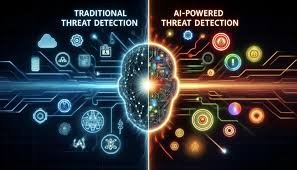
AI vs Traditional Cybersecurity
| Feature | Traditional Security | AI-Powered Security |
|---|---|---|
| Detection Speed | Slower | Real-time |
| Threat Adaptability | Limited | Learns and adapts |
| False Positives | Higher | Reduced with training |
| Automation | Minimal | Extensive |
AI enables proactive defense instead of reactive response.
The Future of AI in Cybersecurity
Emerging trends include:
- AI-driven zero-trust architectures
- Predictive vulnerability scanning
- Autonomous security operations centers (SOC)
- AI-based fraud prevention systems
- Integration with cloud-native security tools
As cyber threats evolve, AI will become a core component of digital defense strategies worldwide.
Conclusion
AI in cybersecurity represents a major leap forward in protecting digital assets. By analyzing massive amounts of data, identifying hidden threats, and responding instantly, AI helps organizations stay ahead of increasingly complex cyberattacks.
However, responsible implementation, human oversight, and ethical considerations remain essential. The future of cybersecurity lies in the collaboration between intelligent machines and skilled professionals.
FAQs (SEO-Optimized)
Q: Can AI completely prevent cyberattacks?
No system is 100% secure, but AI significantly improves detection and response capabilities.
Q: Is AI replacing cybersecurity professionals?
No. AI enhances security teams by automating repetitive tasks and providing faster insights.
Q: Can hackers use AI too?
Yes. Cybercriminals are also leveraging AI, which makes defensive AI even more critical.