The financial industry has experienced significant innovation over the past decade, and one of the most transformative developments has been Decentralized Finance (DeFi). Built on blockchain technology, DeFi aims to provide financial services such as lending, borrowing, trading, payments, and asset management without relying on traditional intermediaries like banks or brokerage firms.
Instead of centralized institutions approving transactions or maintaining financial records, DeFi applications use smart contracts—self-executing programs stored on blockchain networks—to automate financial activities. These applications allow users to interact directly with decentralized protocols while maintaining control of their digital assets.
DeFi has expanded rapidly, creating an ecosystem of decentralized exchanges, lending platforms, liquidity pools, derivatives, insurance protocols, tokenized assets, and cross-chain financial applications. While these innovations offer increased accessibility and transparency, they also introduce technical, security, and regulatory challenges that users should understand before participating.
This comprehensive guide explains how DeFi works, its core components, advantages, risks, practical applications, and the trends expected to shape decentralized finance in the coming years.
What Is DeFi?
Decentralized Finance (DeFi) is a collection of blockchain-based financial applications that provide services traditionally offered by banks and financial institutions.
These services include:
- Lending
- Borrowing
- Trading
- Saving
- Investing
- Payments
- Insurance
- Asset management
Unlike traditional finance, DeFi protocols generally operate through smart contracts and distributed blockchain networks rather than centralized organizations.
How DeFi Works
DeFi applications operate using blockchain technology and programmable smart contracts.
A typical workflow includes:
- A user connects a compatible crypto wallet.
- The wallet interacts with a decentralized application (dApp).
- Smart contracts execute transactions based on predefined rules.
- Transactions are recorded on a public blockchain.
- Users retain control of their wallet and private keys.
Most DeFi activity occurs without opening a traditional bank account, though users should understand applicable laws and tax obligations in their jurisdiction.
Core Technologies Behind DeFi
Blockchain
Blockchain provides the distributed infrastructure that records transactions transparently and immutably.
Key characteristics include:
- Decentralization
- Transparency
- Security
- Consensus mechanisms
- Public verification
Smart Contracts
Smart contracts automatically execute agreements when predefined conditions are met.
They enable:
- Automated lending
- Token exchanges
- Interest calculations
- Liquidity management
- Governance voting
Because smart contracts are software, vulnerabilities or coding errors can create risks if not properly audited.
Cryptocurrency Wallets
Wallets allow users to:
- Store digital assets
- Sign blockchain transactions
- Access decentralized applications
- Manage tokens
- Interact with multiple blockchain networks
Users are responsible for protecting their recovery phrases and private keys.
Major Components of DeFi
Decentralized Exchanges (DEXs)
DEXs allow users to trade cryptocurrencies directly from their wallets.
Advantages include:
- Non-custodial trading
- Greater transparency
- Direct wallet interaction
- Reduced reliance on intermediaries
Users should understand liquidity, slippage, and smart contract risks before trading.
Lending Platforms
DeFi lending enables users to:
- Supply digital assets
- Earn interest
- Borrow against collateral
- Access liquidity
Collateral requirements vary by protocol.
Borrowing
Borrowers typically deposit cryptocurrency as collateral before borrowing other digital assets.
Common use cases include:
- Short-term liquidity
- Leveraged trading
- Portfolio management
Borrowers should monitor collateral ratios to reduce liquidation risk.
Liquidity Pools
Liquidity pools are collections of digital assets supplied by users.
They help decentralized exchanges process trades without traditional order books.
Liquidity providers may earn fees generated by trading activity, though returns can vary.
Yield Farming
Yield farming involves allocating digital assets to DeFi protocols with the goal of earning rewards.
Potential rewards include:
- Interest
- Trading fees
- Incentive tokens
Returns are not guaranteed and may fluctuate significantly.
Staking
Some blockchain networks allow participants to lock eligible assets to help secure the network.
Potential benefits include:
- Network participation
- Validator support
- Staking rewards
Availability depends on the blockchain’s consensus mechanism.
Stablecoins in DeFi
Stablecoins are cryptocurrencies designed to maintain relatively stable value.
They are commonly used for:
- Payments
- Lending
- Trading
- Liquidity pools
- Savings strategies
Different stablecoins use different mechanisms to maintain stability, and users should understand those mechanisms before relying on them.
Tokenization
Tokenization represents real-world or digital assets on blockchain networks.
Potential examples include:
- Real estate
- Artwork
- Commodities
- Securities (subject to regulation)
- Intellectual property
Tokenization may improve efficiency and accessibility, though legal treatment varies by jurisdiction.
DeFi Governance
Many DeFi projects allow token holders to participate in governance.
Governance decisions may include:
- Protocol upgrades
- Fee adjustments
- Treasury management
- Community proposals
Participation does not eliminate the need for careful project evaluation.
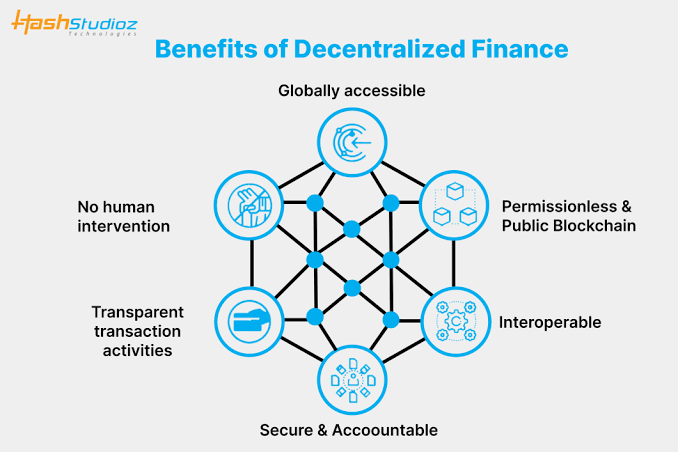
Benefits of DeFi
Accessibility
Users with internet access and a compatible wallet can often access DeFi applications regardless of geographic location, subject to local legal restrictions.
Transparency
Most DeFi transactions are publicly verifiable on blockchain networks.
This transparency allows users to inspect transaction history and smart contract activity.
User Control
Many DeFi applications are non-custodial, meaning users maintain control of their assets through their own wallets rather than depositing funds with a centralized intermediary.
Automation
Smart contracts automate many financial operations, reducing manual processing and enabling continuous operation.
Global Availability
Many DeFi services are available around the clock without traditional banking hours.
Risks of DeFi
Smart Contract Risk
Programming errors or vulnerabilities may result in unexpected behavior or financial losses.
Users should favor protocols that have undergone reputable security audits, while recognizing that audits cannot eliminate all risk.
Market Volatility
Cryptocurrency prices can fluctuate significantly.
Sharp price movements may affect collateral values and investment outcomes.
Impermanent Loss
Liquidity providers may experience impermanent loss when the value of pooled assets changes relative to holding those assets separately.
Understanding this concept is important before providing liquidity.
Liquidation Risk
Borrowers who fail to maintain sufficient collateral may have positions liquidated automatically.
Monitoring collateral levels is essential.
Regulatory Uncertainty
Regulations affecting DeFi continue to evolve worldwide.
Users should remain informed about legal and tax requirements in their jurisdiction.
Fraud and Scams
Some projects may involve fraudulent schemes or misleading claims.
Before participating:
- Research the development team where identifiable
- Review documentation
- Check community discussions
- Examine security audits
- Avoid unrealistic return promises
Common DeFi Use Cases
DeFi supports a wide variety of financial activities, including:
- Peer-to-peer lending
- Borrowing against digital assets
- Cross-border payments
- Decentralized trading
- Portfolio diversification
- Automated investment strategies
- Token issuance
- Treasury management
The suitability of each use case depends on the user’s goals and risk tolerance.
DeFi and Traditional Finance
| Traditional Finance | Decentralized Finance |
|---|---|
| Banks manage accounts | Users manage their own wallets |
| Business hours | Often available 24/7 |
| Centralized intermediaries | Smart contracts and decentralized protocols |
| Manual approvals | Automated execution where applicable |
| Limited transparency | Public blockchain records |
| Geographic restrictions may apply | Often globally accessible, subject to local laws |
DeFi Security Best Practices
Protecting digital assets should be a priority.
Recommended practices include:
- Use reputable wallet software or hardware wallets where appropriate.
- Enable Multi-Factor Authentication on related accounts when available.
- Verify website URLs carefully.
- Never share recovery phrases or private keys.
- Keep software updated.
- Start with small transactions when trying new protocols.
- Review smart contract permissions periodically.
- Stay informed about security updates.
The Role of AI in DeFi
Artificial intelligence is increasingly being used to:
- Analyze blockchain activity
- Detect suspicious transactions
- Assess protocol risk
- Improve customer support
- Enhance fraud detection
- Generate market insights
AI-generated analysis should complement, not replace, independent research.
Institutional Interest in DeFi
Financial institutions are exploring blockchain technologies for:
- Asset tokenization
- Cross-border settlement
- Digital asset custody
- On-chain financial infrastructure
- Operational efficiency
Adoption varies depending on regulatory and technical considerations.
Challenges Facing DeFi
Despite rapid growth, DeFi faces several ongoing challenges:
Scalability
Blockchain congestion can increase transaction costs and reduce processing speed.
User Experience
Managing wallets, private keys, and blockchain transactions can be complex for new users.
Developers continue working to improve usability.
Security
Maintaining secure smart contracts and infrastructure remains essential as the ecosystem evolves.
Interoperability
Cross-chain communication is improving but remains an active area of development.
Compliance
Balancing decentralization with regulatory expectations continues to be an important challenge for the industry.
Future Trends in DeFi
Cross-Chain Ecosystems
Future DeFi applications are expected to support smoother interactions across multiple blockchain networks.
Tokenized Real-World Assets
Tokenization of traditional assets may expand access to investment opportunities, subject to applicable regulations.
Improved Security
Advances in formal verification, auditing, and monitoring tools aim to reduce protocol vulnerabilities.
AI-Assisted DeFi
AI may increasingly support risk management, analytics, and fraud detection within decentralized financial systems.
Better User Experience
Wallets and decentralized applications are expected to become more intuitive, helping lower barriers for new users.
DeFi Adoption Checklist
Before using any DeFi platform, make sure you:
- ✅ Learn the basics of blockchain and smart contracts.
- ✅ Understand how cryptocurrency wallets work.
- ✅ Protect your recovery phrase and private keys.
- ✅ Research the protocol’s reputation and documentation.
- ✅ Review available security audits.
- ✅ Understand transaction fees and network costs.
- ✅ Learn the risks of lending, borrowing, and liquidity provision.
- ✅ Start with small amounts while gaining experience.
- ✅ Track transactions for accounting and tax purposes where required.
- ✅ Stay informed about regulatory developments in your country.
Conclusion
Decentralized Finance represents one of the most innovative developments in the blockchain ecosystem, offering new ways to access financial services without relying solely on traditional intermediaries. Through smart contracts and decentralized protocols, users can lend, borrow, trade, provide liquidity, and participate in governance while maintaining direct control over their digital assets.
However, DeFi is still an evolving ecosystem that carries technical, financial, and regulatory risks. Smart contract vulnerabilities, market volatility, liquidation events, and fraudulent projects highlight the importance of careful research and sound security practices. Participating responsibly requires understanding both the opportunities and the limitations of decentralized financial systems.
As blockchain infrastructure, interoperability, security, and user experience continue to improve, DeFi is expected to remain an important area of innovation within digital finance. Whether you are an investor, developer, or technology enthusiast, developing a solid understanding of DeFi can help you navigate this rapidly changing landscape more confidently.
Frequently Asked Questions (FAQs)
1. What is DeFi?
DeFi (Decentralized Finance) is a blockchain-based ecosystem of financial applications that enables services such as lending, borrowing, trading, and investing through smart contracts rather than traditional financial intermediaries.
2. Is DeFi safe?
DeFi can offer transparency and user control, but it also carries risks including smart contract vulnerabilities, scams, market volatility, and liquidation risk. Users should research protocols carefully and follow strong security practices.
3. Do I need a bank account to use DeFi?
Many DeFi applications can be accessed using a compatible cryptocurrency wallet. However, users remain responsible for complying with local laws, regulations, and tax obligations.
4. What is a liquidity pool?
A liquidity pool is a collection of digital assets supplied by users to facilitate decentralized trading. Liquidity providers may earn fees, but they should also understand risks such as impermanent loss.
5. What is the difference between DeFi and traditional finance?
Traditional finance relies on centralized institutions such as banks and brokers, while DeFi generally uses blockchain networks and smart contracts to provide financial services in a decentralized manner.