

Cyberattacks have become one of the biggest threats facing businesses, governments, and individuals. From ransomware attacks and data breaches to phishing campaigns and insider threats, organizations must be prepared not only to prevent cyber incidents but also to respond effectively when they occur.
This is where Incident Response and Recovery (IRR) plays a critical role.
Incident Response (IR) is the process of identifying, managing, and mitigating cybersecurity incidents, while Recovery focuses on restoring normal operations and minimizing business disruption after an attack.
In 2026, organizations face increasingly sophisticated threats powered by automation, Artificial Intelligence (AI), and advanced malware. Having a strong incident response and recovery strategy is no longer optional—it’s essential for business continuity and digital resilience.
This article explores the importance of incident response, key phases of the response lifecycle, recovery strategies, common challenges, best practices, and future trends in cybersecurity incident management.
🔍 What is Incident Response?
Incident Response (IR) is a structured approach used by organizations to detect, investigate, contain, and eliminate cybersecurity threats.
The primary goals of incident response are to:
- Minimize damage
- Reduce recovery time
- Protect sensitive data
- Maintain business operations
- Prevent future incidents
A well-executed incident response plan can significantly reduce the impact of cyberattacks.
⚠️ Common Cybersecurity Incidents
Organizations face a wide range of cyber threats, including:
🦠 Malware Attacks
Malicious software designed to damage systems, steal data, or disrupt operations.
Examples include:
- Trojans
- Worms
- Spyware
- Keyloggers
🔒 Ransomware Attacks
Ransomware encrypts files and demands payment for their release.
These attacks can:
- Halt business operations
- Cause financial losses
- Damage brand reputation
🎣 Phishing Attacks
Cybercriminals use deceptive emails, messages, or websites to steal credentials and sensitive information.
👤 Insider Threats
Employees, contractors, or trusted individuals may intentionally or accidentally compromise security.
🌐 Distributed Denial-of-Service (DDoS) Attacks
Attackers overwhelm systems with traffic, making services unavailable to legitimate users.
🛡️ The Incident Response Lifecycle
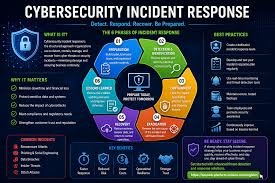
Most cybersecurity frameworks follow a six-phase incident response model.
1️⃣ Preparation
Preparation is the foundation of effective incident response.
Organizations should:
- Develop an incident response plan
- Create response procedures
- Train employees
- Conduct security awareness programs
- Implement monitoring tools
- Maintain secure backups
Preparation significantly improves response efficiency during real incidents.
2️⃣ Detection & Identification
The next step involves identifying potential security incidents.
Security teams use:
- Security Information and Event Management (SIEM) systems
- Endpoint Detection and Response (EDR) tools
- Network monitoring solutions
- Threat intelligence feeds
Indicators of compromise may include:
- Unusual login activity
- Unauthorized access attempts
- Suspicious network traffic
- Unexpected file changes
3️⃣ Containment
Once an incident is detected, immediate containment is necessary.
Containment strategies may include:
- Disconnecting affected systems
- Blocking malicious IP addresses
- Disabling compromised accounts
- Isolating infected devices
The goal is to prevent the attack from spreading further.
4️⃣ Eradication
After containment, organizations remove the root cause of the incident.
This may involve:
- Deleting malware
- Removing unauthorized accounts
- Applying security patches
- Correcting vulnerabilities
Security teams must ensure all traces of the threat are eliminated.
5️⃣ Recovery
Recovery focuses on restoring affected systems and services.
Activities include:
- Recovering data from backups
- Rebuilding servers
- Restoring applications
- Monitoring systems for recurring threats
Organizations should carefully verify systems before returning them to production.
6️⃣ Lessons Learned
Every incident provides valuable insights.
Post-incident reviews help organizations:
- Identify weaknesses
- Improve policies
- Strengthen defenses
- Update response procedures
Continuous improvement is a critical part of cybersecurity resilience.
☁️ The Role of AI in Incident Response
Artificial Intelligence is transforming incident response operations.
AI-powered tools can:
- Detect anomalies in real time
- Identify suspicious behavior
- Prioritize alerts
- Automate investigations
- Accelerate response actions
AI helps security teams manage large volumes of security data more efficiently.
📊 Incident Response Tools
Modern organizations rely on specialized tools to improve response capabilities.
🔍 SIEM Platforms
Security Information and Event Management solutions collect and analyze security logs.
Popular examples include:
- Splunk
- Microsoft Sentinel
🛡️ Endpoint Detection & Response (EDR)
EDR tools monitor and protect endpoints such as computers and servers.
Examples include:
- CrowdStrike
- SentinelOne
🌐 Network Monitoring Tools
These solutions help identify suspicious network activity and potential intrusions.
💾 Disaster Recovery & Business Continuity
Incident response is closely connected to disaster recovery planning.
Organizations should maintain:
- Secure backups
- Redundant systems
- Recovery procedures
- Communication plans
Business continuity ensures critical operations continue during and after a cyber incident.
🔐 Best Practices for Incident Response
✅ Create an Incident Response Plan
Document clear procedures for handling cyber incidents.
✅ Conduct Regular Security Training
Employees should understand how to identify and report threats.
✅ Maintain Updated Backups
Regular backups help organizations recover quickly after ransomware or system failures.
✅ Test Response Procedures
Conduct simulations and tabletop exercises regularly.
✅ Implement Continuous Monitoring
Real-time visibility improves detection and response capabilities.
⚖️ Compliance & Regulatory Considerations
Many industries must follow cybersecurity regulations that require incident response procedures.
Examples include:
- Data protection laws
- Financial security regulations
- Healthcare compliance standards
Organizations may also be required to report breaches within specific timeframes.
🌍 Incident Response in the Age of Remote Work
Remote and hybrid work environments create new security challenges.
Organizations must secure:
- Remote devices
- Home networks
- Cloud applications
- Employee accounts
Identity management and endpoint security have become essential components of incident response.
🔮 Future Trends in Incident Response & Recovery
🤖 Autonomous Response Systems
AI-powered platforms will increasingly automate incident containment and remediation.
☁️ Cloud-Native Security Operations
More incident response capabilities will move to cloud-based environments.
🧠 Predictive Threat Intelligence
Advanced analytics will help organizations anticipate attacks before they occur.
🔐 Zero Trust Integration
Incident response strategies will align closely with Zero Trust security models.
🌐 Extended Detection & Response (XDR)
XDR platforms will provide unified visibility across endpoints, networks, cloud services, and applications.
📈 Building a Cyber-Resilient Organization
Cyber resilience goes beyond preventing attacks. It focuses on an organization’s ability to:
- Detect threats quickly
- Respond effectively
- Recover efficiently
- Adapt continuously
Organizations that invest in incident response and recovery capabilities are better positioned to withstand evolving cyber threats.
🏁 Final Thoughts
Cybersecurity incidents are no longer a question of “if” but “when.” As threats become more sophisticated, businesses must develop comprehensive incident response and recovery strategies to protect their operations, customers, and reputation.
A strong incident response framework enables organizations to detect threats early, contain attacks quickly, recover efficiently, and learn from each event. Combined with AI-powered security tools, employee awareness, and robust recovery planning, incident response becomes a powerful defense against modern cyber threats.
In 2026, organizations that prioritize cybersecurity preparedness and resilience will be far better equipped to navigate the increasingly complex digital threat landscape.