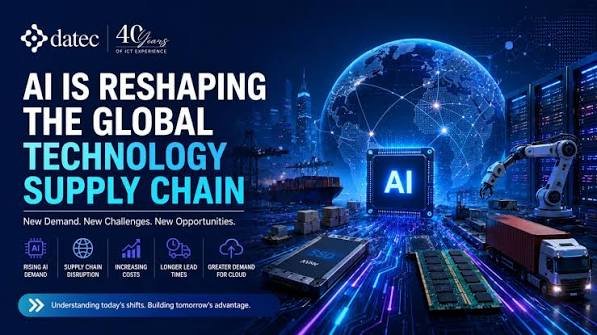
The technology industry is entering a new phase in which artificial intelligence is no longer simply a software story. Across the global market, AI is increasingly influencing semiconductor production, cloud computing, data centers, custom processors, cybersecurity and the way major technology companies finance infrastructure.
Recent developments show how quickly this transformation is happening. Companies are committing enormous amounts of capital to computing infrastructure, while chipmakers, cloud providers and AI companies are forming increasingly complex partnerships to secure the computing power required for the next generation of AI systems.
AI Is Becoming an Infrastructure Business
The rapid adoption of generative and agentic AI has created demand for enormous amounts of computing capacity. Training and operating advanced AI systems require specialized processors, high-bandwidth memory, networking equipment and large data centers.
This has shifted the competitive landscape. The technology companies benefiting from the AI boom are no longer limited to companies developing AI models. Semiconductor manufacturers, cloud providers, networking companies and data-center operators have all become important parts of the AI ecosystem.
Deloitte’s 2026 semiconductor outlook notes that chip sales remain strong while companies increasingly focus on managing demand risks, system-level integration and investment strategies.
The result is a technology industry where infrastructure decisions can have a direct impact on the development and availability of AI services.
Big Tech Is Looking for New Ways to Finance AI Expansion
One of the most significant developments is the growing cost of AI infrastructure.
Reuters reported that Broadcom could provide Anthropic with financing of up to $42 billion connected to a five-year commitment involving AI chips. The arrangement illustrates how relationships between AI developers and infrastructure suppliers are becoming more financially interconnected.
Amazon is also exploring new financing structures for its AI infrastructure. According to the Financial Times, the company is considering transferring approximately $8 billion worth of Nvidia AI chips into a special-purpose vehicle and leasing the equipment back. The strategy would allow Amazon to finance infrastructure while using a more asset-light structure.
These developments highlight a broader issue facing the technology industry: building AI infrastructure requires not only technical expertise but also innovative approaches to capital and financing.
Custom AI Chips Are Becoming More Important
Graphics processing units have played a central role in the AI boom, but technology companies are increasingly developing custom processors designed for specific workloads.
Cloud providers are investing heavily in their own AI accelerators because specialized chips can potentially improve efficiency and reduce dependence on external suppliers.
Industry reporting indicates that hyperscale cloud providers are expanding their networks of partners for custom application-specific integrated circuits, or ASICs. There are also expectations of increasing competition between ASIC-based accelerators and general-purpose GPUs as AI workloads mature.
Amazon, for example, has expanded its custom silicon efforts through partnerships designed to accelerate chip development for cloud infrastructure and AI-powered products. A recently announced agreement with Synopsys was valued at more than $1 billion.
This could make custom silicon one of the important areas to watch as the AI infrastructure market develops.
Semiconductor Supply Remains a Critical Industry Issue
AI growth is also increasing pressure on the semiconductor supply chain.
Advanced AI processors require sophisticated manufacturing processes and high-performance memory. Companies therefore need access to chip fabrication capacity, advanced packaging and specialized memory technologies.
Taiwan remains a particularly important part of this global ecosystem. Recent industry developments have also shown governments and technology companies paying greater attention to semiconductor supply chains and regional manufacturing capabilities.
The United States, meanwhile, has continued supporting domestic semiconductor development. In July 2026, the U.S. Department of Commerce announced letters of intent involving $874 million in incentives for seven companies working on semiconductor technologies for AI and advanced computing.
For businesses, this means semiconductor availability is increasingly becoming a strategic issue rather than simply a procurement concern.
Data Centers Are Becoming Central to the Technology Economy
Behind every major AI service is physical infrastructure.
Data centers provide the electricity, cooling, networking and computing capacity required to operate modern AI systems. As AI adoption increases, companies are building and expanding facilities at an unprecedented scale.
This expansion is creating opportunities for data-center operators, chip manufacturers, energy companies, construction firms, networking providers and cooling-technology companies.
It is also creating new challenges. Large-scale AI data centers can require substantial amounts of electricity and water, making energy availability and infrastructure planning increasingly important business considerations.
Amazon recently announced a $1 billion investment over five years in communities hosting its data centers, with funding aimed at areas including education, workforce development and resource preservation. The announcement comes amid increasing attention to the economic and environmental effects of large data-center developments.
AI Is Changing the Cybersecurity Industry Too
AI is not only creating opportunities for technology companies; it is also changing the cybersecurity threat landscape.
Attackers can use AI to automate parts of cyber operations, generate convincing social-engineering content and accelerate certain stages of attacks. At the same time, cybersecurity companies are developing AI-powered systems to detect suspicious activity and respond more quickly.
Thales CEO Patrice Caine recently argued that organizations need to increase investment in defensive AI because attackers are increasingly using AI-enabled techniques. Thales has also highlighted new cybersecurity products and a partnership with Google Cloud focused on securing AI operations.
This creates a technological arms race in which businesses need to consider both the opportunities and security risks associated with AI adoption.
What These Developments Mean for Businesses
The latest technology-industry developments point toward several important changes for businesses.
First, AI infrastructure is becoming a major competitive advantage. Companies with access to sufficient computing capacity can develop, deploy and scale AI applications more efficiently.
Second, technology budgets are increasingly moving toward infrastructure. AI adoption requires more than purchasing software. Businesses may need cloud resources, data infrastructure, cybersecurity controls, specialized applications and employee training.
Third, the semiconductor industry is becoming increasingly strategic. Supply-chain disruptions or shortages can affect everything from AI services to consumer electronics.
Finally, AI investment is expanding beyond technology companies. Financial institutions, manufacturers, healthcare companies, retailers and professional-services businesses are increasingly looking for ways to incorporate AI into their operations.
The Technology Industry Is Moving Toward a New Competitive Model
The AI boom is creating a technology ecosystem that is considerably more interconnected than previous software cycles.
AI developers depend on chipmakers. Chipmakers depend on semiconductor manufacturing and advanced packaging. Cloud providers require enormous data centers. Data centers require energy, cooling and networking infrastructure. Investors and financial institutions are increasingly involved in financing the expansion.
This interconnected structure means that a development in one part of the technology industry can quickly affect companies across several other sectors.
The coming years are therefore likely to be shaped not just by which company develops the most capable AI model, but also by which organizations can build, finance, secure and operate the infrastructure needed to make AI available at global scale.
Conclusion
The latest technology industry developments demonstrate that AI has evolved into a much broader economic and infrastructure story.
From semiconductor manufacturing and custom AI chips to cloud computing, data centers, cybersecurity and innovative financing, companies across the technology ecosystem are adapting to rapidly increasing demand for AI capabilities.
For businesses and technology professionals, understanding these changes is becoming increasingly important. The next stage of the technology industry will depend not only on advances in AI software but also on the infrastructure, capital and supply chains that make those advances possible.