

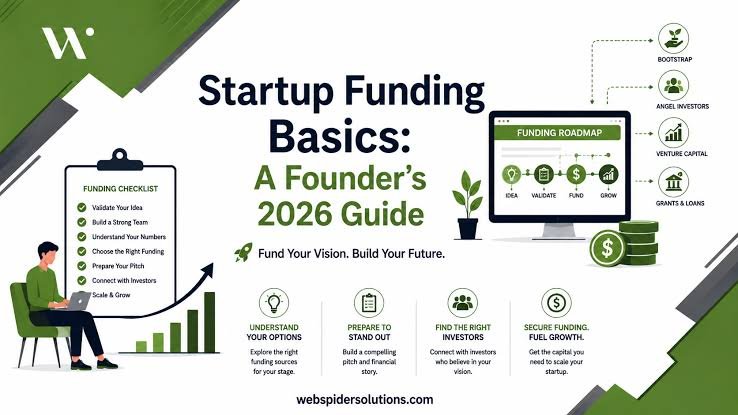
Building a startup requires more than a strong idea.
Founders need a viable product, a clear market opportunity, talented people, and enough capital to turn an idea into a sustainable business. For many high-growth startups, venture capital (VC) can provide the funding needed to develop products, hire employees, acquire customers, and expand into new markets.
But raising venture capital is not simply a matter of presenting an idea and asking for money.
Founders must understand how the funding ecosystem works, what investors look for, how startup valuations are determined, what happens during a funding round, and what accepting outside capital means for the future of the company.
This guide explores the fundamentals of venture capital and startup funding, from early-stage financing to later-stage investment.
What Is Venture Capital?
Venture capital is a form of investment in which investors provide capital to startups and other high-growth companies in exchange for an ownership interest or another form of financial participation.
VC investors typically look for companies with the potential to grow significantly.
Unlike traditional business loans, venture capital generally does not require a startup to make regular loan repayments. Instead, investors accept the risk of losing their investment in exchange for the possibility of substantial returns if the company becomes highly successful.
This makes venture capital particularly relevant to technology startups, software companies, biotechnology companies, fintech businesses, and other ventures with significant growth potential.
How Does Venture Capital Work?
The basic VC model is relatively straightforward:
- Founders build a company.
- Investors evaluate the opportunity.
- Investors provide capital.
- The company uses the funding to grow.
- Investors receive an ownership stake or other agreed financial rights.
- If the company becomes significantly more valuable, investors may eventually realize a return through an exit.
The exit could involve:
- Acquisition
- Merger
- Initial public offering (IPO)
- Secondary transaction
- Other liquidity event
However, not every startup reaches an exit.
Venture capital is inherently risky, and investors understand that some portfolio companies may fail.
Why Do Startups Raise Venture Capital?
Startups typically raise VC funding to accelerate growth.
Capital can be used for:
- Product development
- Hiring
- Marketing
- Sales
- Research and development
- Infrastructure
- International expansion
- Customer acquisition
- New product launches
- Business operations
The key word is acceleration.
A startup may be able to grow organically, but additional capital can allow it to pursue opportunities more quickly.
Venture Capital vs. Traditional Business Loans
Venture capital and debt financing operate differently.
| Venture Capital | Business Loan |
|---|---|
| Usually involves ownership or investment rights | Requires repayment |
| Investors take significant business risk | Lender expects repayment |
| No traditional monthly loan repayment | Usually has scheduled repayments |
| Often targets high-growth startups | Can serve many types of businesses |
| Investors may provide networks and expertise | Lender primarily provides capital |
| Founder ownership may be diluted | Usually no equity dilution |
Neither option is automatically better.
The appropriate funding method depends on the company’s business model, growth plans, financial position, and founder objectives.
The Main Startup Funding Stages
Startup funding is often divided into several stages.
Pre-Seed Funding
Pre-seed funding is typically used when a company is still developing its idea or early product.
Capital may come from:
- Founders
- Friends and family
- Angel investors
- Startup accelerators
- Early-stage funds
Funding may support:
- Market research
- Prototyping
- Product development
- Initial hiring
Seed Funding
Seed funding generally supports a startup that has moved beyond the earliest concept stage.
A startup may use seed capital to:
- Build its product
- Find product-market fit
- Hire a core team
- Acquire initial customers
- Test its business model
At this stage, investors are often evaluating the size of the opportunity and the startup’s ability to execute.
Series A
A Series A round generally occurs when a startup has demonstrated meaningful progress and is looking to scale.
Investors may examine:
- Revenue
- User growth
- Customer retention
- Product-market fit
- Market size
- Unit economics
- Growth strategy
The company may use the capital to build a larger team, expand sales and marketing, and improve its product.
Series B
Series B funding is typically associated with companies that have already demonstrated a stronger business model and are seeking additional growth.
Capital may support:
- Geographic expansion
- Larger sales teams
- Product expansion
- Infrastructure
- Acquisitions
- Operational scaling
The company may have substantially greater revenue and customer traction than it had during earlier rounds.
Series C and Later Rounds
Later-stage funding can support companies that are already established and looking to expand significantly.
Potential uses include:
- International growth
- Large acquisitions
- New business divisions
- Major infrastructure investment
- Preparing for an eventual public offering
The exact structure and purpose of later rounds varies significantly between companies.
Who Provides Startup Funding?
Different investors participate at different stages.
Angel Investors
Angel investors are individuals who invest their own money in startups.
They may provide:
- Capital
- Industry expertise
- Mentorship
- Business connections
Angels can be particularly important during pre-seed and seed stages.
Venture Capital Firms
VC firms raise capital from investors and use that capital to invest in startups and other companies.
Their investors may include institutions and other sophisticated investors.
A VC firm typically has a specific investment strategy.
For example, a fund may focus on:
- Enterprise software
- Artificial intelligence
- Fintech
- Healthcare technology
- Climate technology
- Consumer technology
- Cybersecurity
Corporate Venture Capital
Some large companies operate corporate venture capital programs.
These investments may provide startups with:
- Capital
- Industry relationships
- Distribution opportunities
- Technical expertise
- Strategic partnerships
However, founders should carefully evaluate the strategic implications of taking investment from a corporate investor.
Accelerators and Incubators
Startup accelerators and incubators can provide early-stage companies with a combination of:
- Funding
- Mentorship
- Education
- Networking
- Workspace
- Investor introductions
Some programs take equity, while structures vary between organizations.
What Do Venture Capital Investors Look For?
There is no universal VC checklist, but investors commonly evaluate several important areas.
1. Market Size
A large and growing market can provide more room for a startup to scale.
Investors may ask:
How large could this company realistically become?
A great product in a very small market may have limited venture-scale potential.
2. Founding Team
Investors often evaluate the founders closely.
Important characteristics may include:
- Relevant expertise
- Product knowledge
- Leadership ability
- Adaptability
- Persistence
- Communication
- Ability to recruit talent
A strong team can sometimes compensate for an early product that still needs refinement.
3. Product
Investors want to understand what the company is building and why customers need it.
Important questions include:
- What problem does the product solve?
- Who needs it?
- Why is the solution better?
- How difficult is it to replicate?
- Is there evidence that customers want it?
4. Traction
Traction provides evidence that the startup is making progress.
Depending on the business, traction could include:
- Revenue
- User growth
- Customer acquisition
- Retention
- Partnerships
- Engagement
- Contracts
- Product adoption
The most meaningful metrics vary by industry.
5. Business Model
Investors need to understand how the company intends to make money.
Common startup models include:
- SaaS subscriptions
- Transaction fees
- Marketplaces
- Advertising
- Licensing
- Enterprise contracts
- Usage-based pricing
- Freemium models
A business does not necessarily need to be profitable during an early funding round, but investors need to understand the path toward a sustainable business.
6. Competitive Advantage
Investors want to know why competitors cannot easily copy the startup.
Potential advantages include:
- Proprietary technology
- Brand
- Network effects
- Distribution
- Data
- Patents
- Strong customer relationships
- Switching costs
- Operational advantages
A startup should clearly explain why its position can become stronger over time.
Startup Valuation Explained
Valuation represents the estimated value of a company.
For startups, valuation can be difficult because many young companies have:
- Limited revenue
- Limited operating history
- Uncertain future growth
- Unproven business models
As a result, startup valuation involves both quantitative and qualitative analysis.
Pre-Money vs. Post-Money Valuation
Two important terms are:
Pre-Money Valuation
The company’s valuation immediately before a new investment.
Post-Money Valuation
The valuation after the investment.
A simplified example:
Suppose a startup has a $8 million pre-money valuation and raises $2 million.
Its simplified post-money valuation would be:
$8 million + $2 million = $10 million
The new investor would own approximately 20% of the company under this simplified example, assuming no other factors affect the ownership calculation.
Real investment structures can be more complicated.
What Is Equity Dilution?
When a startup issues new shares to investors, existing shareholders generally own a smaller percentage of the company.
This is called dilution.
For example, imagine a founder initially owns 100% of a company.
If the company later issues shares representing 20% ownership to investors, the founder’s percentage ownership will decrease.
However, dilution is not necessarily negative.
If the investment helps the company grow substantially, owning a smaller percentage of a much more valuable business can be better than owning 100% of a company with limited growth.
What Is a Term Sheet?
A term sheet outlines the major terms proposed for an investment.
It may cover:
- Investment amount
- Valuation
- Ownership
- Liquidation preferences
- Voting rights
- Board representation
- Investor protections
- Option pool
- Conversion terms
A term sheet is an important step before final legal agreements are prepared.
Founders should have qualified legal and financial professionals review investment documents before signing.
What Is a Cap Table?
A capitalization table, commonly called a cap table, shows who owns what percentage of a company.
It can include:
- Founders
- Employees
- Investors
- Option pools
- Other equity holders
Maintaining an accurate cap table becomes increasingly important as a startup completes multiple funding rounds.
What Is an Employee Option Pool?
Startups often reserve a portion of their equity for current or future employees.
An option pool can help startups:
- Recruit talent
- Retain employees
- Align incentives
- Reward key team members
However, founders should understand how creating or expanding an option pool affects ownership.
How to Prepare for a VC Fundraising Round
Fundraising should ideally begin before the company urgently needs money.
A startup preparing for a funding round should organize its business information.
Important materials may include:
- Pitch deck
- Financial model
- Cap table
- Product information
- Customer metrics
- Market research
- Growth data
- Legal documents
- Business plan
- Investor pipeline
Good preparation makes the fundraising process more efficient.
Building a Strong Pitch Deck
A startup pitch deck should communicate the opportunity clearly and quickly.
A typical structure might include:
- Company introduction
- Problem
- Solution
- Product
- Market
- Business model
- Traction
- Competition
- Competitive advantage
- Go-to-market strategy
- Team
- Financial information
- Funding request
- Use of funds
The exact structure can vary depending on the company and investor.
What Makes a Strong Startup Pitch?
A strong pitch should answer several fundamental questions:
What problem exists?
Why does the problem matter?
What are you building?
Who needs it?
Why now?
How large is the opportunity?
Why is your team capable of winning?
How will the business make money?
How much capital are you raising?
What will you accomplish with the funding?
How Much Funding Should a Startup Raise?
There is no universal amount.
Founders should determine how much capital is required to reach the next meaningful milestone.
That could be:
- Launching the product
- Reaching a specific revenue target
- Acquiring a certain number of customers
- Expanding into a new market
- Achieving product-market fit
Rather than raising money simply because it is available, founders should have a clear plan for how the capital will be used.
Understanding Runway
Runway refers to how long a startup can continue operating before it needs additional funding, based on its current cash position and spending rate.
A simplified calculation is:
Runway = Cash Available ÷ Monthly Net Burn
For example, if a startup has $600,000 available and spends $50,000 more each month than it generates, its simplified runway would be approximately:
12 months
Actual runway calculations should account for changing revenue, expenses, hiring plans, and other financial variables.
What Is Burn Rate?
Burn rate measures how quickly a startup is using cash.
Two common concepts are:
Gross Burn
The total amount the company spends during a period.
Net Burn
The amount spent after accounting for revenue.
Monitoring burn rate helps founders understand whether their current funding strategy is sustainable.
How VCs Evaluate Startup Risk
Venture capital investors understand that startups are risky.
They may evaluate:
- Market risk
- Product risk
- Technology risk
- Competitive risk
- Regulatory risk
- Financial risk
- Team risk
- Customer concentration
- Execution risk
Founders should not hide legitimate risks.
Instead, they should demonstrate that they understand those risks and have strategies for addressing them.
Common Startup Funding Mistakes
1. Raising Too Early
Some founders attempt to raise VC funding before demonstrating enough evidence of demand.
Depending on the business, it may be better to establish early traction first.
2. Raising Too Much
More capital is not automatically better.
A large funding round can create pressure to grow rapidly and may result in unnecessary dilution.
3. Raising Too Little
The opposite problem can also occur.
If a startup raises insufficient capital to reach its next milestone, it may need to return to investors sooner than expected.
4. Focusing Only on Valuation
A high valuation may sound attractive, but founders should consider the complete investment agreement.
Other terms can significantly affect future ownership and control.
5. Ignoring Investor Fit
Not every investor is suitable for every startup.
Consider:
- Industry experience
- Network
- Geographic focus
- Investment stage
- Portfolio
- Follow-on funding capability
- Communication style
6. Poor Financial Planning
Investors expect founders to understand their numbers.
Founders should know:
- Revenue
- Gross margin
- Burn
- Runway
- Customer acquisition costs
- Retention
- Growth rates
- Major expenses
Bootstrapping vs. Venture Capital
Bootstrapping means funding the company primarily through founder resources and business revenue.
Advantages of Bootstrapping
- Greater founder control
- Less dilution
- More flexibility
- No investor fundraising pressure
Disadvantages
- Slower growth
- Limited resources
- Greater financial pressure on founders
- Potentially fewer investor connections
Advantages of Venture Capital
- Significant growth capital
- Access to investor networks
- Potential strategic support
- Ability to hire and expand faster
Disadvantages
- Equity dilution
- Greater investor involvement
- Growth expectations
- Pressure to achieve significant returns
The right approach depends on the startup’s goals.
Other Sources of Startup Funding
Venture capital is only one funding option.
Startups may also consider:
- Bootstrapping
- Angel investment
- Crowdfunding
- Grants
- Startup accelerators
- Revenue-based financing
- Bank loans
- Venture debt
- Strategic investment
- Government programs
Founders should compare the cost, risk, control implications, and eligibility requirements of each option.
How AI Is Changing Venture Capital
Artificial intelligence is increasingly being used across the investment ecosystem.
Potential applications include:
- Market research
- Competitive analysis
- Financial analysis
- Document analysis
- Deal sourcing
- Due diligence
- Portfolio monitoring
- Customer research
However, AI-generated analysis should supplement human judgment rather than replace it.
Investment decisions involve uncertainty, relationships, market dynamics, and qualitative factors that automated systems may not fully capture.
The Future of Startup Funding
The startup funding ecosystem continues to evolve.
Several developments are likely to remain important:
AI Startups
AI continues to attract significant attention from investors because of its potential to transform software, enterprise operations, healthcare, finance, education, and other industries.
More Efficient Capital
Investors may increasingly focus on startups that can achieve meaningful revenue with smaller teams and more efficient infrastructure.
Alternative Financing
Founders have access to a growing range of funding models beyond traditional VC.
Global Startup Ecosystems
Entrepreneurs can increasingly build companies and access investors across geographic boundaries.
Greater Focus on Fundamentals
Revenue quality, retention, margins, customer demand, and sustainable growth remain important indicators of business health.
Frequently Asked Questions
What is venture capital?
Venture capital is investment provided to startups and high-growth companies in exchange for equity or other financial rights, with investors seeking significant returns if the business succeeds.
Do startups have to repay venture capital?
Traditional equity investment generally does not work like a conventional loan. Investors receive an ownership interest and accept the possibility of losing their investment.
What is the difference between seed funding and Series A?
Seed funding generally supports early product development and validation, while Series A typically supports companies that have demonstrated meaningful traction and are preparing to scale.
How do VCs make money?
VC investors generally seek returns when their investment becomes more valuable and they eventually realize that value through an exit or another liquidity event.
How do I attract venture capital investors?
Develop a strong product, demonstrate market demand, build a capable team, understand your financial metrics, prepare a clear pitch, and target investors whose strategy matches your company.
Does taking VC funding mean losing control?
It can reduce founder ownership and may introduce investor rights or governance arrangements. The extent depends on the investment terms.
What is startup dilution?
Dilution occurs when new shares are issued and existing shareholders’ percentage ownership decreases.
How much equity should founders give investors?
There is no universal percentage. The appropriate arrangement depends on valuation, funding requirements, company stage, investor terms, and future financing needs. Professional legal and financial advice can help founders evaluate specific offers.
Can a small business raise venture capital?
Potentially, but traditional VC typically targets businesses capable of significant growth. A profitable small business may be better suited to bootstrapping, loans, or other forms of financing.
Is venture capital right for every startup?
No. VC is most appropriate for companies pursuing substantial growth where external capital can accelerate expansion and potentially generate venture-scale returns.
Final Thoughts
Venture capital can provide startups with the resources needed to move faster, hire stronger teams, develop products, and enter larger markets.
But raising investment also comes with trade-offs.
Founders may give up part of their ownership, accept additional governance requirements, and take on expectations for rapid growth. The goal should therefore not simply be to raise as much money as possible.
The better objective is to raise the right amount of capital from the right investors at the right stage.
A successful fundraising strategy begins with a strong business foundation: a meaningful problem, a compelling solution, a capable team, evidence of demand, disciplined financial management, and a realistic growth plan.
For founders, understanding VC and funding is not just about getting an investment. It is about choosing a financing strategy that gives the company the best chance of building a durable and valuable business.


