

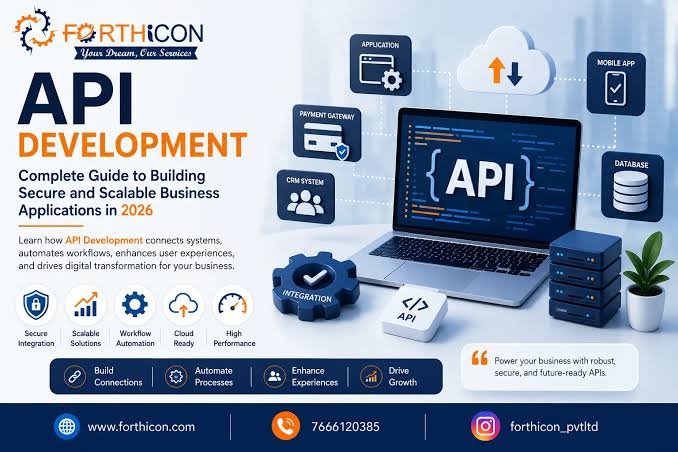
Artificial Intelligence (AI) has moved beyond research labs and into everyday software. From intelligent chatbots and virtual assistants to recommendation engines, image recognition systems, fraud detection platforms, and code generation tools, AI is now a core component of modern digital products.
One of the biggest reasons for AI’s rapid adoption is the availability of AI APIs (Application Programming Interfaces). Instead of building complex machine learning models from scratch, developers can integrate powerful AI capabilities into websites, mobile apps, enterprise software, and cloud platforms using well-documented APIs.
At the same time, advances in cloud computing, Large Language Models (LLMs), AI agents, vector databases, and automation frameworks have made AI development more accessible than ever. Businesses of all sizes can now create intelligent applications that improve customer experiences, automate workflows, analyze data, and support better decision-making.
This guide explores AI development fundamentals, explains how AI APIs work, introduces modern development architectures, highlights best practices, and examines future trends that will shape the next generation of intelligent software.
What Is AI Development?
AI development is the process of designing, building, integrating, testing, deploying, and maintaining software applications that use artificial intelligence to perform tasks typically requiring human intelligence.
These tasks include:
- Understanding natural language
- Image recognition
- Speech processing
- Predictive analytics
- Recommendation systems
- Decision support
- Content generation
- Workflow automation
Modern AI development often combines cloud services, APIs, automation, and machine learning rather than relying solely on custom-built models.
What Is an AI API?
An AI API (Application Programming Interface) allows software applications to access AI capabilities provided by another service.
Instead of building models internally, developers send requests to an AI service and receive responses such as:
- Text generation
- Language translation
- Image analysis
- Speech recognition
- Voice synthesis
- Object detection
- Sentiment analysis
- Code assistance
This approach significantly reduces development complexity and infrastructure requirements.
Why AI APIs Matter
AI APIs enable developers to:
- Build applications faster
- Reduce infrastructure costs
- Access continuously improved AI models
- Scale applications more easily
- Focus on business logic instead of model training
- Deliver advanced AI features without specialized machine learning expertise
They have become the foundation of many modern AI-powered applications.
Types of AI APIs
Natural Language Processing (NLP)
NLP APIs support:
- Chatbots
- Text summarization
- Translation
- Grammar correction
- Sentiment analysis
- Document classification
- Information extraction
These services enable applications to understand and generate human language.
Large Language Model (LLM) APIs
LLM APIs power conversational AI and advanced reasoning tasks.
Common use cases include:
- Virtual assistants
- Customer support
- Coding assistants
- Content generation
- Research support
- Knowledge retrieval
Developers typically provide prompts and receive structured or natural language responses.
Computer Vision APIs
Vision APIs analyze images and video.
Applications include:
- Facial recognition (where legally appropriate)
- Object detection
- OCR (Optical Character Recognition)
- Image classification
- Barcode scanning
- Quality inspection
These APIs are widely used in retail, manufacturing, healthcare, and logistics.
Speech APIs
Speech technologies include:
- Speech-to-text
- Text-to-speech
- Voice recognition
- Speaker identification
- Voice commands
These capabilities support accessibility and voice-enabled applications.
Recommendation APIs
Recommendation systems personalize user experiences by suggesting:
- Products
- Videos
- Articles
- Music
- Courses
- Advertisements
Personalization improves engagement and customer satisfaction.
REST APIs and AI
Most AI services are accessed through REST APIs.
Typical workflow:
- The application sends a request.
- Authentication verifies access.
- The AI service processes the request.
- The response is returned in a structured format (often JSON).
- The application displays or processes the results.
Understanding API design is essential for modern AI development.
Authentication and API Security
Protecting AI services requires secure authentication.
Common approaches include:
- API keys
- OAuth
- Access tokens
- Role-based permissions
- Rate limiting
Developers should never expose secrets in client-side code or public repositories.
AI Development Architecture
A typical AI-powered application includes:
- Frontend interface
- Backend server
- Authentication service
- AI API integration
- Database
- Logging and monitoring
- Security controls
Cloud-native architectures help applications scale efficiently.
Prompt Engineering
Prompt engineering is the practice of designing effective instructions for AI models.
Good prompts often include:
- Clear objectives
- Context
- Constraints
- Desired output format
- Examples (when appropriate)
Well-designed prompts improve consistency and reduce ambiguity.
Retrieval-Augmented Generation (RAG)
RAG combines AI language models with external knowledge sources.
Instead of relying solely on model training data, the application retrieves relevant information from trusted databases or documents before generating a response.
Benefits include:
- More current information
- Better factual accuracy
- Organization-specific knowledge
- Improved transparency
RAG is widely used in enterprise AI assistants.
Vector Databases
Vector databases store numerical representations (embeddings) of text, images, and other data.
They support:
- Semantic search
- Similarity matching
- Knowledge retrieval
- AI assistants
- Personalized recommendations
Vector search has become an important component of modern AI systems.
AI Agents
AI agents extend language models by allowing them to:
- Plan tasks
- Use tools
- Access external APIs
- Retrieve information
- Execute workflows
- Make limited autonomous decisions under defined constraints
Organizations increasingly use AI agents to automate business processes while maintaining human oversight.
Building AI-Powered Applications
Common AI applications include:
Customer Support
AI chatbots answer questions, summarize conversations, and assist human agents.
Content Creation
AI supports drafting, editing, brainstorming, translation, and personalization.
Business Intelligence
AI analyzes business data to identify trends, forecast demand, and support decision-making.
Healthcare
AI assists with medical documentation, image analysis, scheduling, and administrative workflows while requiring appropriate clinical oversight.
Software Development
AI helps developers generate code, explain documentation, identify bugs, and automate repetitive programming tasks.
Cloud AI Services
Cloud platforms provide managed AI infrastructure that simplifies deployment.
Benefits include:
- Automatic scaling
- High availability
- Security controls
- Managed infrastructure
- Global accessibility
- Continuous updates
Organizations can focus more on application development than infrastructure management.
Testing AI Applications
AI systems require testing beyond traditional software validation.
Areas to evaluate include:
- Accuracy
- Reliability
- Response consistency
- Latency
- Hallucination risk
- Safety
- Bias
- Security
Testing should continue throughout the application’s lifecycle.
Responsible AI Development
Responsible AI involves building systems that are:
- Fair
- Transparent
- Reliable
- Secure
- Privacy-conscious
- Accountable
Developers should document AI behavior, validate outputs, and provide appropriate human oversight for high-impact decisions.
Security Considerations
AI applications should be protected against:
- Prompt injection
- Unauthorized API access
- Data leakage
- Model abuse
- Sensitive information exposure
- Malicious inputs
Strong authentication, monitoring, input validation, and logging improve security.
Common Challenges
Developers often encounter:
API Costs
Usage-based pricing requires careful monitoring and optimization.
Latency
Complex AI requests may increase response times. Caching and efficient architecture can improve performance.
Hallucinations
Language models may generate incorrect or fabricated information. Critical outputs should be verified.
Privacy
Organizations should minimize unnecessary collection of sensitive information and comply with applicable privacy regulations.
Vendor Dependence
Applications relying on external AI providers should plan for service changes, pricing updates, and availability considerations.
Future Trends in AI Development
Several innovations are expected to shape AI development in the coming years.
More Capable AI Agents
AI agents will become better at coordinating tools, completing workflows, and assisting professionals while remaining under human supervision.
Multimodal AI
Future AI systems will increasingly understand and generate combinations of text, images, audio, video, and structured data within unified workflows.
Smaller Specialized Models
Organizations will adopt compact models optimized for specific industries, devices, and business tasks.
Edge AI
More AI processing will occur directly on local devices, improving privacy, reducing latency, and supporting offline functionality.
Improved AI Governance
Organizations will invest in stronger oversight, auditing, documentation, and lifecycle management for AI systems.
Best Practices for AI Development
Successful AI projects typically:
- Start with a clearly defined business problem.
- Choose the appropriate AI capabilities.
- Protect API credentials.
- Validate AI outputs.
- Monitor performance continuously.
- Maintain human oversight where needed.
- Optimize prompts and workflows.
- Document system behavior.
- Prioritize user privacy.
- Update applications regularly.
AI Development Checklist
Before launching an AI application:
- ✅ Define your use case.
- ✅ Select appropriate AI APIs.
- ✅ Design secure authentication.
- ✅ Protect sensitive data.
- ✅ Test prompts thoroughly.
- ✅ Monitor costs and usage.
- ✅ Validate AI responses.
- ✅ Implement logging and monitoring.
- ✅ Review security and privacy requirements.
- ✅ Continuously improve based on user feedback.
Conclusion
AI development has become significantly more accessible through the availability of powerful APIs, cloud services, and advanced language models. Developers no longer need to build every machine learning model from scratch to deliver intelligent features. Instead, they can combine AI APIs, modern software architecture, and responsible development practices to create applications that automate tasks, enhance decision-making, and improve user experiences.
As AI capabilities continue to evolve, developers who understand APIs, prompt engineering, retrieval techniques, security, governance, and scalable architecture will be well positioned to build the next generation of intelligent software. Success in AI development depends not only on technical implementation but also on designing systems that are reliable, secure, transparent, and aligned with user needs.
Frequently Asked Questions (FAQs)
1. What is AI development?
AI development is the process of building software applications that use artificial intelligence technologies such as machine learning, natural language processing, computer vision, and automation to perform intelligent tasks.
2. What is an AI API?
An AI API allows developers to integrate artificial intelligence capabilities—such as text generation, image analysis, speech recognition, or language translation—into applications without building AI models from scratch.
3. What is Retrieval-Augmented Generation (RAG)?
RAG is an AI architecture that combines language models with external knowledge sources, enabling applications to retrieve relevant information before generating responses, which can improve accuracy and relevance.
4. Why is prompt engineering important?
Prompt engineering helps developers provide clear instructions and context to AI models, improving response quality, consistency, and task performance.
5. What are the biggest challenges in AI development?
Common challenges include API costs, latency, hallucinations, privacy protection, security, vendor dependence, and ensuring responsible AI use through testing and human oversight.