

Cyberattacks are no longer a question of if—but when. From ransomware and phishing to data breaches and system compromises, organizations of all sizes face increasing cybersecurity threats.
That’s why having a strong Incident Response & Recovery (IRR) strategy is critical. It helps businesses detect, respond to, and recover from cyber incidents quickly—minimizing damage, downtime, and financial loss.
In this guide, we’ll break down what incident response is, why it matters, key phases, tools, and best practices.
What Is Incident Response?
Incident response is a structured approach to identifying, managing, and resolving cybersecurity incidents.
Organizations often rely on frameworks from National Institute of Standards and Technology and SANS Institute to build effective response strategies.
Why Incident Response Matters
Minimizes Damage
Quick response reduces impact.
Protects Data
Prevents sensitive data loss.
Reduces Downtime
Faster recovery keeps operations running.
Ensures Compliance
Meets legal and regulatory requirements.
Improves Preparedness
Helps organizations handle future threats.
Types of Cybersecurity Incidents
Malware Attacks
Viruses, ransomware, spyware.
Phishing Attacks
Fraudulent emails or messages.
Data Breaches
Unauthorized access to sensitive data.
Insider Threats
Malicious or negligent employees.
Denial-of-Service (DoS)
Overloading systems to disrupt services.
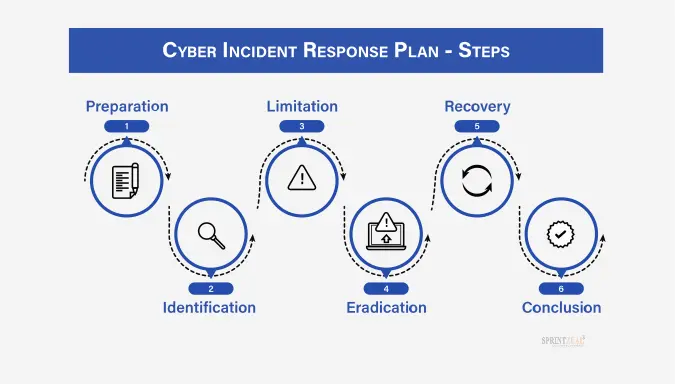
Phases of Incident Response
Preparation
Activities
- Develop response plans
- Train teams
- Set up tools
Identification
Activities
- Detect unusual activity
- Analyze alerts
- Confirm incidents
Containment
Activities
- Isolate affected systems
- Prevent spread
Eradication
Activities
- Remove threats
- Fix vulnerabilities
Recovery
Activities
- Restore systems
- Monitor for recurrence
Lessons Learned
Activities
- Review incident
- Improve processes
Incident Response Tools
SIEM Systems
Security monitoring and analysis.
Endpoint Detection & Response (EDR)
Identify threats on devices.
Threat Intelligence Platforms
Provide insights into threats.
Backup Solutions
Restore lost data.
Recovery Strategies
Data Backups
Regularly back up critical data.
Disaster Recovery Plans
Ensure business continuity.
System Restoration
Rebuild affected systems.
Communication Plans
Inform stakeholders.
Best Practices for Incident Response
Create an Incident Response Plan
Document procedures.
Train Your Team
Regular drills and simulations.
Monitor Systems Continuously
Detect threats early.
Use Automation
Speed up response times.
Maintain Backups
Ensure quick recovery.
Common Challenges
Lack of Preparation
No clear response plan.
Slow Detection
Delayed identification of threats.
Resource Constraints
Limited tools or expertise.
Communication Gaps
Poor coordination during incidents.
Future Trends in Incident Response
AI-Powered Detection
Faster and smarter threat identification.
Automation & Orchestration
Streamlined response workflows.
Zero Trust Security
Continuous verification of users.
Cloud Security Focus
Protecting cloud environments.
Proactive Defense
Threat hunting and prevention.
Real-World Example
Ransomware Attack
Scenario
A company’s systems are encrypted by attackers.
Response
- Identify the attack
- Isolate infected systems
- Remove malware
- Restore from backups
How to Build an Incident Response Plan
Step 1: Define Roles
Assign responsibilities.
Step 2: Identify Assets
Know what to protect.
Step 3: Develop Procedures
Create step-by-step actions.
Step 4: Test the Plan
Run simulations.
Step 5: Update Regularly
Adapt to new threats.
Final Thoughts
Incident Response & Recovery is a vital component of any cybersecurity strategy. As cyber threats continue to evolve, organizations must be prepared to respond quickly and effectively.
By implementing strong response plans, using the right tools, and continuously improving processes, businesses can minimize risks and ensure resilience.
In cybersecurity, preparation is your strongest defense.
SEO FAQs
Q: What is incident response?
A process for handling cybersecurity incidents.
Q: Why is incident response important?
It minimizes damage and speeds recovery.
Q: What are the key phases of incident response?
Preparation, identification, containment, eradication, recovery.
Q: How can businesses improve incident response?
By training teams, using tools, and maintaining plans.


