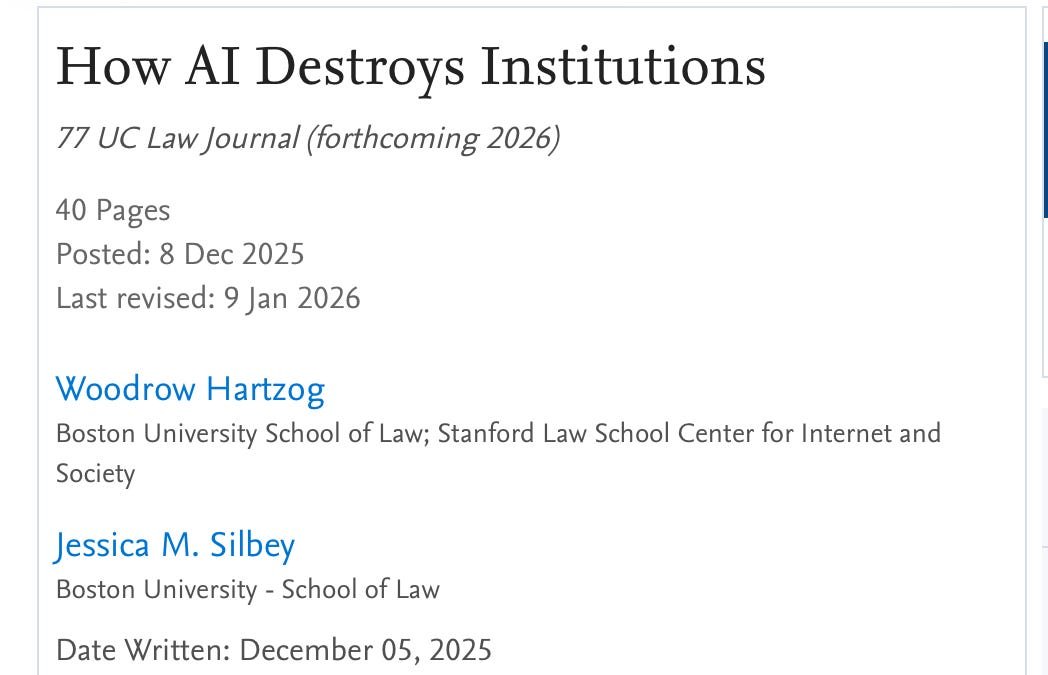
The Implications of AI on Democratic Institutions: A Critical Examination by Hartzog and Silbey
In a world where technology shapes our realities, two Boston University law professors, Woodrow Hartzog and Jessica Silbey, have made an urgent call to attention with their thought-provoking preprint paper, "How AI Destroys Institutions." This piece stands out for its powerful critique of the current trajectory of artificial intelligence (AI), particularly focusing on its impact on institutions fundamental to democratic governance.
The Call to Action: Understanding the Dangers of AI
The essence of Hartzog and Silbey’s work rests in a startling observation: AI, particularly in its current generative forms, serves as a catalyst for institution degradation. Their abstract encapsulates a core truth we often overlook; when AI is leveraged in governance, education, healthcare, and even journalism, it doesn’t merely enhance efficiency. Instead, it actively undermines the foundational structures that uphold democracy and civic life.
One of the more alarming messages from their research is that AI systems, often promoted as neutral efficiency tools, carry the inherent risk of hollowing out essential institutions. The authors argue that the deployment of AI may not directly end these institutions but rather enfeebles them to the point of collapse, weakening their roles in society.
The Authors’ Evolution of Thought
What makes this paper particularly engaging is its backstory. Initially conceived as a positive follow-up to an earlier work entitled "The Upside of Deep Fakes," the authors set out to explore the potential benefits of emerging technologies. However, as they delved deeper, reality took a sobering turn. They found that AI’s implications were far more hazardous than anticipated. This transformation of purpose—from optimism to caution—reflects a necessary evolution in thinking about technology’s role in our lives.
In their original research, the authors claimed that technologies like deep fakes merely exacerbate existing vulnerabilities in institutions. Yet, as Hartzog and Silbey maintained focus on current AI systems, they recognized that these technologies might instigate a new wave of destruction against our democratic fortifications. This realization pushed them to convey the urgency of their findings, laying bare the various mechanisms through which AI erodes institutional integrity.
AI’s Core Functionalities: A Threat to Cooperation and Accountability
A pivotal insight from the paper is how AI’s design is fundamentally at odds with the core functionalities of vital institutions. The authors argue that AI lacks the attributes necessary for fostering the cooperation, transparency, and accountability essential for institutional sustainability. Unlike humans, AI systems operate on algorithms devoid of nuance, empathy, or social responsibility, which leads to outcomes that can further delegitimize the institutions we depend on.
When institutions like bureaucracies and universities start to rely on AI for decision-making, they risk becoming ossified, losing adaptability and relevance in the process. This entrenchment could leave a vacuum where civic participation, a cornerstone of democracy, once thrived. Instead of elevating public structures, AI has the potential to render them ineffective.
The Ripple Effects on Democratic Life
The paper also widens the lens to look at the broader societal implications of AI’s integration into public institutions. The consequences are dire: the degradation of democratic processes, erosion of public trust, and increased vulnerability to authoritarian practices. When institutions lose their legitimacy, citizens may retreat from civic engagement, exposing democracies to greater risks.
Hartzog and Silbey assert that, regardless of the intentions of tech companies and policy-makers, the design characteristics of AI are incompatible with the essential democratic values we hold dear. Their observations underline a paradox: as we pursue efficiency through AI, we might inadvertently pave the way for authoritarianism disguised as progress.
A Call for Reflection: Addressing the Threat of AI
As the conversation around AI grows increasingly complex, Hartzog and Silbey’s paper urges us to confront the ramifications of our technological choices. Their statement that AI may serve as a "death sentence" for civic institutions demands serious reflection. It compels us to think critically about how we wish to shape the future of our democratic structures and what role technology will play within them.
Moreover, the chronicle of how this paper evolved from a positive outlook into a stark warning illustrates the importance of remaining adaptive and responsive to ongoing societal changes. The authors’ journey speaks volumes about the need for constant vigilance and a proactive approach to integrating technology into civic life.
Taking Action: What Can Be Done?
In response to this dire forecast, discussions on AI regulation and ethical standards within technology are no longer just academic—they have become pressing societal needs. Engaging with experts, policymakers, and technologists, and advocating for frameworks that prioritize human well-being over mere efficiency will be essential. Hartzog and Silbey’s urgent narrative serves as a rallying cry for policymakers and society at large to reassess the integration of AI into the fabric of democratic life.
As you consider their findings, reflect on the practical implications: How will we safeguard our institutions in the face of rapidly advancing technology? How can we ensure that AI serves democracy rather than undermines it? Engaging with these questions will be critical as we navigate this transformative era.
Read the full paper here and immerse yourself in this essential discourse surrounding AI and its profound implications for our society.