Cyberattacks have become more frequent, sophisticated, and costly than ever before. Organizations of all sizes—from startups and small businesses to multinational enterprises—face threats such as ransomware, phishing attacks, insider threats, data breaches, denial-of-service attacks, and supply chain compromises. While preventing attacks remains a top priority, no security system is completely immune to cyber incidents.
This is where Incident Response (IR) and Recovery become essential. A well-prepared incident response strategy enables organizations to detect attacks quickly, limit damage, preserve critical evidence, restore business operations, and learn from each event to strengthen future defenses.
Without a structured response plan, organizations often experience longer outages, greater financial losses, reputational damage, legal complications, and increased recovery costs. On the other hand, companies with mature incident response capabilities can significantly reduce downtime, improve resilience, and maintain customer trust.
This comprehensive guide explains what incident response and recovery involve, why they matter, the phases of an effective response plan, common cyber incidents, recovery strategies, best practices, and future trends shaping cybersecurity resilience.
What Is Incident Response?
Incident Response (IR) is the organized process of identifying, investigating, containing, eliminating, and recovering from cybersecurity incidents.
Its objectives include:
- Minimizing business disruption
- Protecting sensitive information
- Preserving digital evidence
- Restoring normal operations
- Preventing similar incidents from recurring
Incident response is not just a technical process—it also involves legal, operational, and communication considerations.
What Is Incident Recovery?
Incident recovery is the phase that focuses on restoring systems, services, and business operations after an incident has been contained.
Recovery activities include:
- Restoring backups
- Rebuilding compromised systems
- Verifying system integrity
- Monitoring for reinfection
- Communicating with stakeholders
- Improving security controls
Recovery ensures organizations return to normal operations safely and securely.
Why Incident Response Matters
Cyber incidents can have far-reaching consequences.
Without an effective response plan, organizations may experience:
- Extended downtime
- Financial losses
- Data theft
- Regulatory penalties
- Loss of customer trust
- Intellectual property exposure
- Operational disruption
An organized incident response process helps reduce these impacts while improving long-term cybersecurity resilience.
Common Types of Cybersecurity Incidents
Organizations must prepare for a wide range of threats.
Ransomware
Attackers encrypt files or systems and demand payment in exchange for a decryption key.
Modern ransomware groups may also steal sensitive data before encryption, increasing pressure on victims.
Phishing Attacks
Phishing attempts trick users into revealing passwords, financial information, or other sensitive data through deceptive emails, messages, or websites.
Malware Infections
Malicious software can:
- Steal information
- Destroy data
- Monitor user activity
- Spread across networks
- Create backdoors for attackers
Data Breaches
Data breaches involve unauthorized access to confidential information such as customer records, financial data, or intellectual property.
Insider Threats
Employees, contractors, or partners may intentionally or unintentionally compromise organizational security.
Distributed Denial-of-Service (DDoS) Attacks
Attackers overwhelm systems with excessive traffic, making services unavailable to legitimate users.
Supply Chain Attacks
Threat actors compromise trusted software vendors or service providers to gain access to downstream organizations.
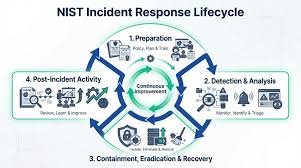
The Incident Response Lifecycle
Most cybersecurity frameworks divide incident response into several key phases.
1. Preparation
Preparation is the foundation of effective incident response.
Organizations should establish:
- Incident response policies
- Response teams
- Communication procedures
- Backup strategies
- Monitoring systems
- Security awareness training
- Recovery plans
Preparation significantly reduces response time during actual incidents.
2. Detection and Analysis
Organizations continuously monitor systems for suspicious activity.
Common detection methods include:
- Security Information and Event Management (SIEM)
- Endpoint Detection and Response (EDR)
- Intrusion Detection Systems (IDS)
- Threat intelligence feeds
- User reports
Analysts investigate alerts to determine whether an incident has occurred.
3. Containment
Containment prevents incidents from spreading.
Examples include:
- Disconnecting infected devices
- Blocking malicious IP addresses
- Disabling compromised accounts
- Isolating affected servers
- Restricting network access
Containment may involve temporary operational disruptions to prevent greater damage.
4. Eradication
Once contained, the root cause must be eliminated.
Activities may include:
- Removing malware
- Closing security vulnerabilities
- Resetting credentials
- Applying security patches
- Deleting malicious files
Organizations should ensure attackers no longer have access before proceeding to recovery.
5. Recovery
Recovery focuses on restoring normal operations.
Typical recovery tasks include:
- Restoring backups
- Rebuilding servers
- Verifying system functionality
- Reconnecting services
- Monitoring systems for unusual behavior
Recovery should occur gradually to reduce the risk of reinfection.
6. Lessons Learned
Every incident provides valuable insights.
Organizations should conduct post-incident reviews to answer questions such as:
- What happened?
- How was it detected?
- What worked well?
- What failed?
- How can future incidents be prevented?
Continuous improvement strengthens long-term resilience.
Building an Incident Response Team
Effective response requires collaboration across multiple disciplines.
An incident response team may include:
- Security analysts
- System administrators
- Network engineers
- Digital forensic specialists
- Legal advisors
- Communications personnel
- Executive leadership
- Human resources representatives
Clearly defined roles improve coordination during high-pressure situations.
Digital Forensics
Digital forensics involves collecting, preserving, and analyzing digital evidence.
Common objectives include:
- Identifying attack methods
- Determining affected systems
- Understanding attacker behavior
- Supporting legal investigations
- Preserving evidence integrity
Maintaining proper documentation throughout the investigation is essential.
Communication During an Incident
Clear communication is critical.
Organizations should establish communication plans for:
- Employees
- Customers
- Business partners
- Executives
- Regulators
- Law enforcement (when appropriate)
Transparent communication helps maintain trust while reducing confusion.
Backup and Disaster Recovery
Reliable backups are essential for recovery.
Organizations should follow backup best practices such as:
- Multiple backup copies
- Offline or immutable backups
- Geographic redundancy
- Regular testing
- Automated backup schedules
A backup is only valuable if it can be restored successfully.
Business Continuity Planning
Business continuity focuses on maintaining essential operations during disruptions.
Plans should identify:
- Critical business functions
- Recovery priorities
- Alternative work arrangements
- Communication procedures
- Recovery objectives
Business continuity complements incident response by minimizing operational impact.
Recovery Objectives
Organizations often define measurable recovery goals.
Recovery Time Objective (RTO)
The maximum acceptable amount of time a service can remain unavailable.
Recovery Point Objective (RPO)
The maximum acceptable amount of data loss measured by time.
These objectives help prioritize recovery efforts.
Ransomware Recovery
Recovering from ransomware requires careful planning.
Recommended actions include:
- Isolate infected systems immediately
- Preserve evidence
- Assess affected assets
- Restore clean backups
- Verify system integrity
- Reset compromised credentials
- Strengthen security controls
Organizations should avoid rushing recovery before confirming the threat has been removed.
Cloud Incident Response
Cloud environments introduce unique considerations.
Response plans should include:
- Cloud access monitoring
- Identity management
- API security
- Configuration reviews
- Shared responsibility awareness
Organizations should understand which security responsibilities belong to the cloud provider and which remain their own.
Incident Response Automation
Automation accelerates response times.
Examples include:
- Automatic account suspension
- Malware isolation
- Threat intelligence enrichment
- Alert prioritization
- Workflow orchestration
Automation improves efficiency but should still include human oversight for critical decisions.
Artificial Intelligence in Incident Response
AI is becoming an important part of modern security operations.
AI supports:
- Threat detection
- Behavioral analytics
- Alert prioritization
- Malware classification
- Automated investigations
While AI improves speed, security analysts remain essential for interpreting complex situations.
Challenges in Incident Response
Organizations commonly face several obstacles.
Alert Fatigue
Security teams may receive thousands of alerts daily.
AI and automation help prioritize genuine threats.
Skills Shortages
Experienced cybersecurity professionals remain in high demand.
Organizations increasingly invest in employee training and managed security services.
Complex IT Environments
Hybrid cloud infrastructure, remote work, IoT devices, and third-party integrations create larger attack surfaces.
Evolving Threats
Cybercriminals continuously develop new attack techniques.
Organizations must regularly update incident response plans.
Best Practices for Incident Response
Develop a Formal Response Plan
Document procedures before incidents occur.
Train Employees
Security awareness reduces the likelihood of successful phishing and social engineering attacks.
Conduct Regular Exercises
Tabletop exercises and simulated attacks help teams practice their response procedures.
Keep Software Updated
Regular patching reduces exploitable vulnerabilities.
Monitor Continuously
Continuous monitoring enables earlier threat detection.
Document Everything
Maintain detailed records of:
- Incident timelines
- Actions taken
- Evidence collected
- Communications
- Recovery activities
Documentation supports audits, investigations, and future improvements.
Common Mistakes to Avoid
Organizations should avoid these common errors:
Delaying Response
Quick action limits damage.
Ignoring Early Warning Signs
Small indicators may signal larger attacks.
Failing to Test Backups
Untested backups may fail when needed most.
Poor Communication
Unclear messaging can create confusion during crises.
Neglecting Post-Incident Reviews
Lessons learned are critical for continuous improvement.
Future Trends in Incident Response
Cybersecurity continues evolving rapidly.
AI-Driven Security Operations
AI will increasingly automate investigations and recommend response actions.
Zero Trust Integration
Incident response will become more closely aligned with Zero Trust security architectures.
Threat Intelligence Sharing
Organizations will collaborate more effectively by sharing anonymized threat intelligence.
Greater Automation
Security orchestration and automated response platforms will continue reducing response times.
Increased Regulatory Requirements
Governments are introducing stricter reporting requirements for cybersecurity incidents, making preparedness even more important.
How Organizations Can Improve Cyber Resilience
Cyber resilience extends beyond prevention.
Organizations should:
- Regularly review incident response plans
- Conduct security assessments
- Test disaster recovery procedures
- Invest in employee training
- Strengthen identity and access management
- Monitor emerging threats
- Foster a security-aware culture
Preparedness is one of the most effective defenses against cyber incidents.
Conclusion
Cybersecurity incidents are no longer a question of if but when. As digital transformation accelerates and cyber threats become more sophisticated, organizations must be prepared to respond quickly, recover efficiently, and continuously strengthen their defenses.
An effective incident response and recovery strategy combines preparation, rapid detection, structured containment, thorough investigation, secure recovery, and ongoing improvement. Supported by technologies such as AI, automation, and advanced monitoring, organizations can reduce downtime, minimize financial losses, and maintain stakeholder confidence even during challenging events.
Ultimately, cyber resilience depends not only on technology but also on people, processes, and planning. Businesses that invest in incident response capabilities today will be far better equipped to navigate tomorrow’s evolving threat landscape.
Frequently Asked Questions (FAQs)
1. What is incident response in cybersecurity?
Incident response is the structured process of detecting, analyzing, containing, eradicating, and recovering from cybersecurity incidents while minimizing business disruption and protecting sensitive data.
2. What is the difference between incident response and disaster recovery?
Incident response focuses on identifying and managing security incidents, while disaster recovery concentrates on restoring systems, data, and business operations after a disruptive event.
3. Why are backups important during incident recovery?
Reliable backups allow organizations to restore systems and data after ransomware attacks, hardware failures, or accidental deletion, reducing downtime and data loss.
4. How does AI improve incident response?
AI helps identify threats faster, prioritize alerts, automate repetitive tasks, detect unusual behavior, and support security analysts with faster investigations and response recommendations.
5. How often should an incident response plan be tested?
Organizations should review and test incident response plans at least annually and after major infrastructure changes or significant cybersecurity incidents. Regular tabletop exercises and simulated attack scenarios help ensure teams remain prepared.